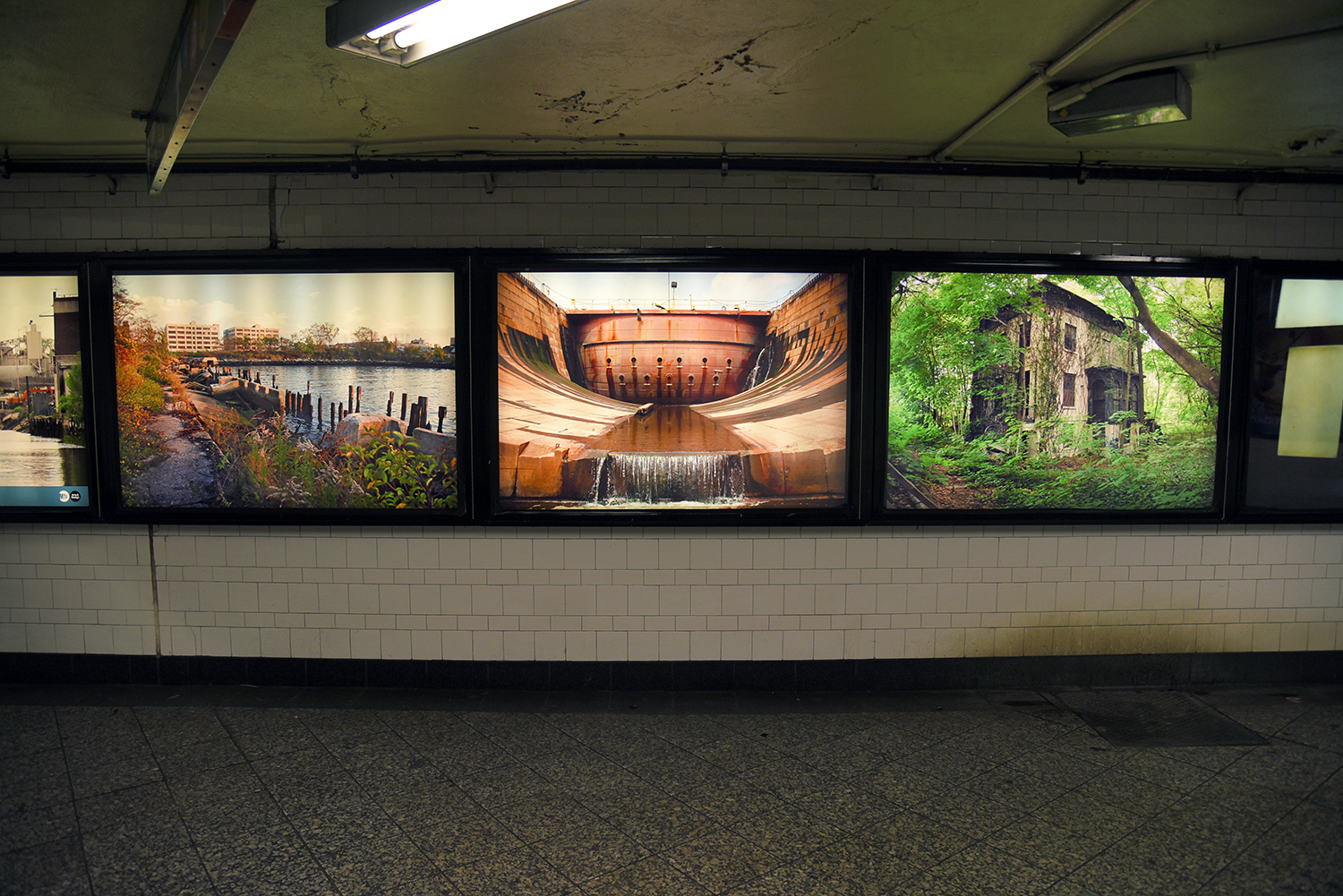
Kingsbridge: Substation No. 3

October 28th 2009 -

If the Harlem River is "New York's forgotten waterfront" then Substation No. 3 is one of the most forsaken places in New York City. Situated on the Bronx shores of the Harlem River, few references can be found to its history, its architect or its purpose. Unlike the well documented Substation No. 10 in Inwood, Substation No. 3 is not even mentioned in the exhaustive Harlem River study written by Columbia's historic preservation program. Just one historic reference to its existence can be found online: an unpublished photograph in the NY Public Library archives, culled from a 1926 collection titled "The Pageant of America - Volume 4: The March of Commerce."

Substation No. 3, also known as the Kingsbridge Substation, is a simple structure. Two stories in height, it is constructed from utilitarian red brick. Inside, two large skylights loom over an open hall. Exposed to the elements, the substation's interior is in relatively poor shape compared to Substation No. 10. Heavy equipment is collapsing into the basement.

Perhaps the most striking thing about this anonymous structure are the numerous objects found inside that indicate a family recently called it home. Luggage, blankets, medication and a toothbrush are tidily arranged around the substation alongside the belongings of several children: stuffed animals, a baseball glove, story books. Like the haunting Victim Services center in Staten Island, these objects hint at a bleak, unwritten history.

Open Skylights


Substation Interior


Layers of Industry


Skater and Toothbrush


Smiling Elephant


Boa and Bunny


"It's All About ME!"


Chopin and Champagne


Flammable Material


To the Basement


The Lower Depths


Arches


Imminent Collapse

Pretty, Vacant: A Slideshow of Abandoned New York


"Pretty, Vacant: A Slideshow of Abandoned New York"

I was recently invited by the Open City Dialogue lecture series to present a selection of my photographs of abandoned New York. In a presentation titled "Pretty, Vacant: A Slideshow of Abandoned New York," I traced the evolution of my photography of New York City, beginning with the San Francisco Navy Yard, which has long been a source of inspiration. The presention explored Red Hook and Brooklyn's industrial waterfront, before expanding out into a variety of sites around Manhattan, Staten Island, the Bronx and Queens.

The lecture was previewed by Time Out New York, which described the photographs as "eye-opening (and sublimely beautiful)." The lecture was also a pick of The NY Times, which wrote "photographer Nathan Kensinger is an inveterate trespasser, climbing around the city’s abandoned buildings and decaying waterfronts to chronicle them. His work... uncovers some of the last unseen parts of New York." In a related article, Flavor Pill wrote that these photos "evoke nostalgia for a New York that most of us never witnessed."

Please note: the slideshow above is a slightly condensed version of the original presentation, and does not include narration.

2009 Red Hook Film Festival


The 3rd annual Red Hook Film Festival took place on October 3rd and 4th, 2009. The festival screened 5 blocks of short films in a Civil War era warehouse on the waterfront of Red Hook, Brooklyn. As an advisor to this year's festival, I was happy to see that they included several films about industry and abandoned spaces, which are two defining aspects of the Red Hook landscape.

On Saturday, the festival opened with "Lavendar Lake" - a portrait of Brooklyn's polluted, industrial Gowanus Canal. Following that was a screening block titled "Abandonment Issues" which includes films set inside abandoned power plants, insane asylums, sewers and factories. On Sunday, the festival presented an "Urban Industry" screening block, with films about rooftop farms, industrial Williamsburg, squatters in the Lower East Side, and a documentary about the Atlantic Yards development titled "Brooklyn Boondoggle."

For more information, visit the festival's website and myspace.

Secret Parties


September 23, 2009 -

The summer of 2009 saw New York's real estate market in crisis. In late May, the NY Post reported that a "squatter explosion" was taking over "foreclosed homes and abandoned construction sites." In July, the New York Times reported that 368 construction projects were stalled around the city - enough to "evoke unnerving images of New York’s abundant vacant lots in the 1970s." And then the Daily News reported that "heroin-addict hobos from around the country" had flooded into New York and were "living in stalled luxury condo projects," prompting one Brooklyn resident to say "it's like St. Marks in the '70s... it's the bad old days all over again."

Besides this wave of squatters, the real estate crisis also spurred a creative response, as several semi-clandestine events were organized throughout the summer of 2009. Set in vacant lots, on boats in polluted canals, inside empty industrial buildings, and around half-empty luxury condo buildings, these events allowed unfettered access to unique parts of the New York landscape. Their locations ranged from DJs spinning on the unsold observation decks of the Williamsburg Savings Bank, to parties inside the massive "urban pirate" ferryboat moored on the Newtown Creek, to swimming in dumpsters in a vacant lot next to the polluted Gowanus Canal. The following photos capture moments from some of this summer's so-called "secret" parties.


"Americans Retreat to Their Inner Line"


"Urban Pirate" Boats


Maze of Industry


Inside the Dome at Night


Dumpster Diving


Captain's Quarters


Down the Aisle


Silenced Halls of Commerce


Dumpster Lights


On the Newtown Creek


Last Night of the Dumpster Pools

The Bronx Swamp

August 31st, 2009 -

The Bronx Swamp is an abandoned, flooded railroad line below the streets of Mott Haven. Its waters are a bright and unnatural green, the color of antifreeze. It is home to birds, rats, raccoons and mosquitos, and has been used as a dumping ground for years. One local told the Daily New Yorker that "dead animals and a human body" were found in the swamp, while the Mott Haven Herald reports that the "foul odor" rising from the swamp's "plastic bags, broken beer bottles, planks of decaying wood, and abandoned basketballs" has forced residents to consider moving out of the neighborhood. The city acknowledges the Bronx Swamp is a health risk - the Deparment of Health & Mental Hygiene regularly sprays it with larvacide to curb the spread of mosquitos potentially infected with the West Nile Virus.

The railroad line underneath the waters of the Bronx Swamp was "formally abandoned" in 2004 by the CSX Corporation, according to the NY Daily News, but - as one resident stated in The Epoch Times - "I've lived here for 17 years and the water's been there just as long." Today, the swamp is scheduled for a major cleanup. It is currently being drained of "more than 150,000 gallons of stagnant water," according to the NY Times. After draining, bulldozers will remove its assorted debris. However, the city has been unable to locate the current owners of the Bronx Swamp and so, as the NY Times states, "the fate of the land remains unclear."

Above the Swamp


Backyard Access


Looking Down to the Cut


Antifreeze Green


At the End of the Swamp


Abandoned Railroad Property


Down in the Swamp


Tunnel Vision


The Bronx Swamp

The Hole

August 25, 2009 -

Locals call it The Hole. But few agree on where The Hole is located. Some say The Hole is in Howard Beach, others say it is in Spring Creek or Ozone Park, or maybe East New York or Lindenwood. Residents do agree on one thing - The Hole is famous. Mostly because of the bodies. Or maybe the horses.

The Hole is a small triangle of land divided in half by Brooklyn and Queens, and is located west of the intersection of Linden and Conduit Boulevard. The Hole is literally a hole. It is "30 feet below grade," according to the NY Times, sunken down from the busy roads around it. The neighborhood floods often and is only a few feet above the water table, so its homes are "not incorporated into the city sewer system. They all have cesspools," according to the NY Times. Streets are threatened by reedy marshes, and many residents keep a boat parked in the driveway.


Marshes, Reeds & Road

The Hole is well known for its holes. The New York Times has called it a "reputed mob dumping ground" while Wikipedia refers to it as "an infamous mob graveyard." People living in the neighborhood tell stories of how "200 dead bodies" were found up the street in a now-abandoned development, or how bodies are frequently "found by the side of the road." These stories are rooted in truth.

In 2004, the FBI descended on the neighborhood, searching for the bodies of up to four men believed to be buried in an empty lot. They began digging in the same location where - 23 years earlier - "the body of a Bonanno crime family captain" was found dead, wrapped in a "yellow carpet," according to the NY Times. Investigators sifted through the soil "like prospectors panning for gold," said the NY Times. Eventually, they discovered what may have been the remains of "two mafia captains" from "the Bonanno crime family" that were buried by "several members of the Gambino family who were close to John Gotti," said the NY Times.

"200 Dead Bodies" Development

Other residents of The Hole reminisce about how it was once populated by vast fields of horses. Many belonged to The Federation of Black Cowboys, who hold an annual rodeo nearby. It was "the closest thing New York has to a border town" with "all the characteristics of a frontier town in the Old West.... dusty streets, stray dogs, ramshackle corrugated tin structures and even a few cowboys," according to the NY Times. There are no longer any horses in The Hole. Beginning in 2002, according to the Village Voice, "about 100 horses" were evicted to make way for a new development. 40 horses still live nearby at Cedar Lane Stables, but there is no evidence that the horse-pasture-development ever happened. Instead, an abandoned house sits at the center of The Hole in a huge empty field. As one local said to The Voice, "it's tough being a cowboy in East New York."

Empty Fields

Today, the neighborhood has been torn apart by failed development schemes. Besides the empty horse pastures and abandoned houses, the edges of the The Hole are dominated by two large, apparently abandoned real estate projects. At the western edge is a trash strewn, boarded-up row of new homes, and towering above the eastern edge of the neighborhood is a stalled development once named "Cobblestone Estates." According to the NY Times, construction here stopped in 2007, and the remaining mountain of debris has given neighbors below in The Hole "nightmares about avalanches" and a "constant fear of a rockslide."

Flooded Lot For Sale


Western Development


"Cobblestone Estates"

Although the future of The Hole is uncertain, it still stands - like The Iron Triangle - as one of the most unique neighborhoods in New York City. Satan's Laundromat once enthusiastically called it "the most obscure neighborhood in New York" and according to Forgotten New York, "this is the true New York, this is NYC with pretense and artifice stripped away." These photos were taken in collaboration with Nate Dorr of Impose Magazine, who says of The Hole "few spots in the five boroughs... feel further from the crowds and activity of Manhattan."

At Home in The Hole


Dead End


Neighborhood Guard


White Truck


Runic Grafitti


Abandoned in The Hole


Living Room Ruins


Pink & Boards


In the Kitchen


Whirlpool at the Center of The Hole


Above The Hole


"Nightmares About Avalanches"


Escape from The Hole

Hamilton Avenue Marine Transfer Station

July 29, 2009 -

In the midst of this summer's debate about superfunding Brooklyn's Gowanus Canal, plans may be quietly proceeding to reopen a sanitation facility on the canal's southern end. Bids are now being accepted to refurbish the Hamilton Avenue Marine Transfer Station, which has been closed since 2001. If reopened, the facility would process tons of Brooklyn garbage by dropping it into barges moored on the banks of the Gowanus.

According to the New York City Council, the Hamilton Avenue Marine Transfer Station was closed when the landfill it delivered trash to - Fresh Kills on Staten Island - was phased out in 2001. This massive two-story steel shed has been decommissioned ever since, although sanitation dumptrucks still park on its upper level. Like the recently demolished sanitation depot on Kent Avenue, it is a humble, functional municipal structure.

A Glorified Shed

In 2006, a new plan for New York City's trash was implemented and The Gowanus Lounge reported that the Hamilton Avenue station would "likely be recommissioned again, ensuring that a very ripe and funky smell indeed will waft through parts of Gowanus... the South Slope, Sunset Park and Red Hook." In 2008, the Department of Environmental Conservation issued a permit valid until 2013 for the facility, and in April and May of this year, numerous bid opportunities to refurbish the structure were published online. Today, construction has not yet begun at the facility, which remains a quiet refuge on this polluted industrial waterway.

Solitary Dumptruck


Safety Blocks


Abandoned Exhaust System


The Dropoff


View to Dumptrucks


Northern Barge Bay


Southern Barge Bay


On The Gowanus