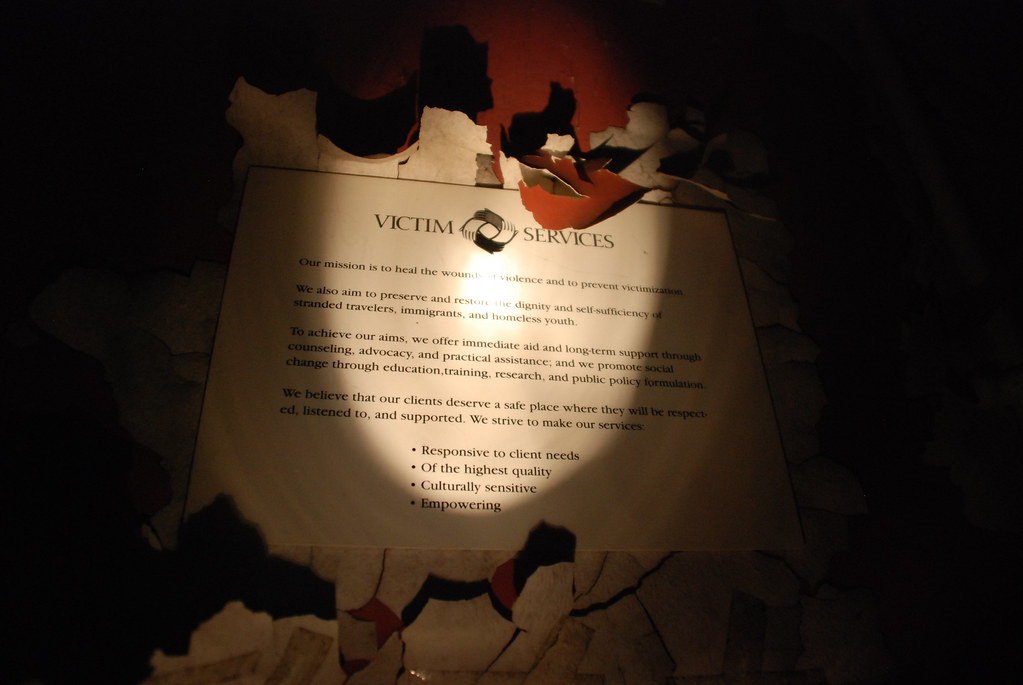
Victim Services - Stapleton, Staten Island

October 29th, 2008 -

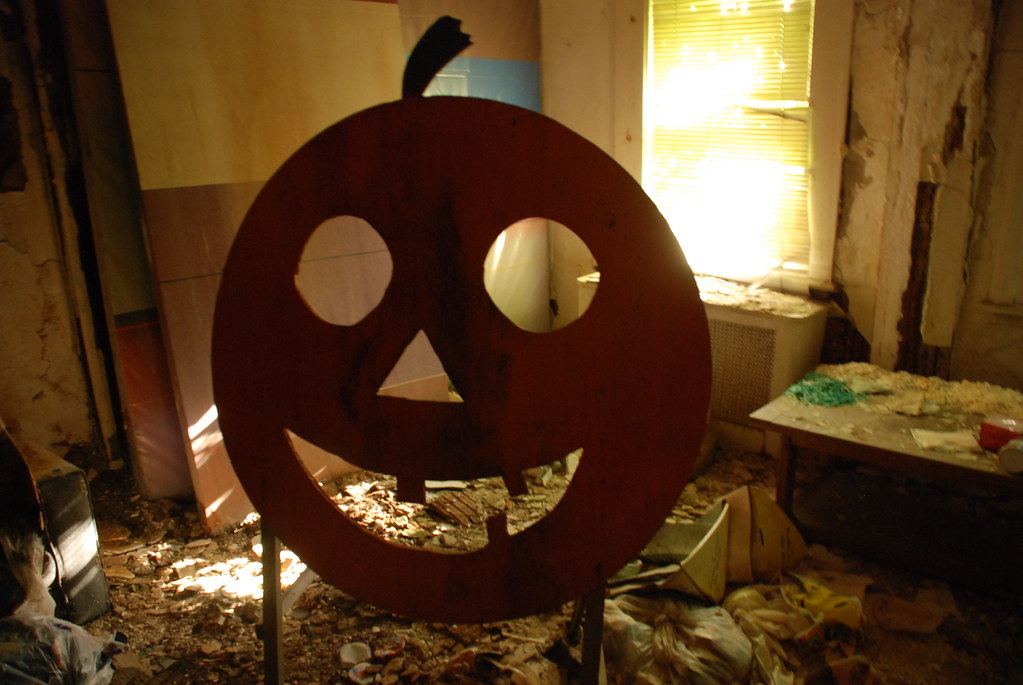
A haunted house is slowly deteriorating on the grounds of a half-abandoned hospital in Staten Island. A piano rots on the collapsing front porch. Inside, there are boxes of severed plaster hands and troll priests. The living room is dominated by a giant jack-o-lantern, while the upper floors show signs this was once home to several children: rusty cribs, broken dolls and tiny, dusty winter coats hanging in a closest. In a dark basement, a poster declares "No One Deserves to be Abused." This was once the Victim Services center of Bayley-Seton Hospital, whose mission was to "restore the dignity... of stranded travelers, immigrants and homeless youth."

But what is most haunting - apart from this sordid past - is the fact that this neglected building is a New York City Landmark. Built in 1842 by unknown architects, the house was landmarked in 1985. The Landmarks Commission's designation report describes the building as "a relatively severe structure" that was once used as the Physician-in-Chief's residence, providing a home to "more then 20 of the hospital's chief medical officers," including a future Surgeon General. The report also states that "the lavishness of the interior provides an unexpected contrast to the severity of the exterior." Today there is no trace of that lavish interior and though it appears somewhat structurally sound, this decaying 166-year-old landmark - like the hospital around it - has a very uncertain future.

When combined with yesterday's decision by the Landmarks Commission to allow St Vincent's Hospital to demolish several of its historic buildings, this is adding up to a grim Halloween for New York's landmarked hospitals.

Additional photos from this exploration - taken by Nate Dorr - can be seen here.




Newtown Creek: The Dutch Kills


October 21, 2008 -

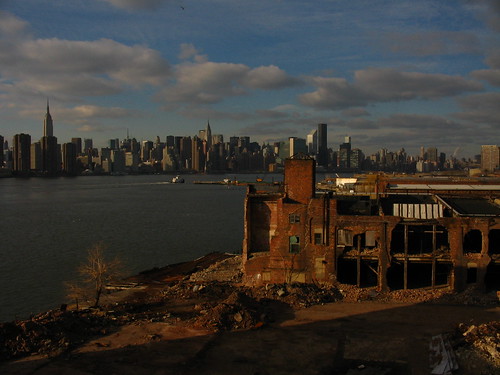
On the Queens side of the Newtown Creek, several small freight lines diverge from the waterfront. Some tracks lead to the Sunnyside Yards, some wander off into dense foliage before disappearing, and others cross rusted old bridges above the Dutch Kills - the northern branch of the Newtown Creek. Beneath this tangled web of tracks, roadways, overpasses, dirt paths and wood-plank walkways lies the creek itself. Its waters are a dark, unnatural green. Nothing appears to live in them. The Newtown Creek is considered to be America's most polluted body of water, and the world's largest urban oil spill. However, as on the south side of the creek, it can also be a quiet haven in the heart of this industrial dead zone.

---
For other photo essays from the Newtown Creek, visit Newtown Creek: Brooklyn Shores (2011), Secret Parties (2009), and Linden Hill Tracks (2007).


The 2008 Red Hook Film Festival


The 2nd annual Red Hook International Film Festival took place in October 2008. It was hosted by the Brooklyn Waterfront Artists Coalition (BWAC) screening room and had free short films, free popcorn, and free Steve's Key Lime Pie. The complete schedule and awards for the festival can be seen here.

As the Festival Director, I made sure to include several great films about industrial New York, including "North Brother" - an exploration of abandoned North Brother Island in the East River, "City of Water" - a great film about the future of New York's waterways, and "Cave Flower" - a love story filmed inside The Batcave on the Gowanus Canal. The festival concluded with several films about old-school New York businesses, including an excerpt from "Counter/Culture" by talented photographers James and Karla Murray, and "Twilight Becomes Night" - a portrait of NYC's dying mom & pop businesses.

The Batcave

New York Waters

Wrigley Building - Rosebank, Staten Island

September 9th, 2008 -

The Wrigley Building is an abandoned 1917 chewing gum factory in Rosebank and part of Staten Island's historic chewing gum heritage. Modern chewing gum was invented on the island with the help of General Santa Ana, the former eleven-time President of Mexico. In 1869, while living in exile on the island, he sold a ton of Mexican chicle to local inventor Thomas Adams. Adams hoped to make rubber tires from the substance. Instead, he created chewing gum. By 1884, he had introduced the world's first flavored stick of gum - Black Jack - which opened the door for future chewing gum kings like the Wrigley Brothers.

The Wrigley Building, referred to in a recent New York Times article about Rosebank, was once used to process chicle. It is not clear when the factory was abandoned, but numerous reports of squatters living in the factory and "kids hanging out in it" date back to 1990. It is now empty, like the abandoned ice factory across the street and the color works nearby. As Rosebank's transformation from industrial to residential continues, this historic factory may soon become a condominium with "92 luxury units."

For further information on gum, read "Chewing Gum: An Unofficial History."


Brooklyn North District 1 Sanitation Garage


August 20th, 2008 -

The blistering pace of development along Kent Avenue, which parallels the East River, has already claimed industrial landmarks like the Kent Avenue Powerhouse and the Domino Sugar Refinery. Next is 50 Kent Avenue, just south of the Bushwick Inlet. Though hardly a landmark, this humble one-story truck depot still contains many interesting artifacts from Brooklyn's industrial past. Once home to the North District 1 Sanitation Garage, its abandoned offices contain leftover American flags, dump truck art and a map of the solar system.

Over $19 million may soon be invested in this simple plot of land. The garage is being redeveloped by the NY Parks Department as part of the city's massive "Greenpoint/Williamsburg Rezoning Plan" - which gave the Parks Department over $183 million to create 50 acres of new parkland along the East River. A recent Parks Department report - the "Fiscal 2009 Preliminary Budget Hearings" - mentions their plan to spend "$13.3 million for the acquisition of 50 Kent Ave. and $5.8 million for the design and construction of the 50 Kent Ave. site." In the meantime, the garage may enjoy a brief new life as a concert venue before demolition.

Update: By June 2009, this building had been completely demolished.


G. Siegle Color Works - Rosebank, Staten Island


August 14, 2008 -

The G. Siegle Company Color Works was a 101 year old factory located in Rosebank, a colorfully named but otherwise quiet Staten Island neighborhood. According to Colorants History, the Color Works was "the oldest pigment plant in North America." It once made pigments of all hues, and the factory's remaining floors, walls, ceilings and equipment are still coated with bright dusts that instantly stain everything they come in contact with. In a recent New York Times article - "Rosebank: When Pink Pigeons Soared the Sky" - neighbors recalled seeing "pink pigeons" and "red-tinted birds, cats or other animals that had apparently frolicked near the powdery pigment produced at the plant." Workers also recalled that at one time, the factory was producing "up to 10,000 pounds a day" of "a shade of yellow" called "7285."

The Color Works was closed in early 2008. Today the demolition of the factory is nearly complete. Through broken walls, the hidden, vibrant colors of the factory are now exposed to the elements.