Gowanus: The Batcave Revisited

Batcave 2010

February 28th, 2010 -

The Batcave once housed a massive squatter community on the banks of the Gowanus Canal. Situated inside a long-abandoned power plant, the squat was allegedly organized around a "communal way of life" with a "bike shop" and "rules about hard drugs and detrimental illegal activity." By 2006, however, the NY Daily News reported that the community had devolved into "a decadent drug culture consumed with vicious fighting" including "mainlined heroin" and "a homeless man... thrown from a window." In response to this lurid article, the building owners evicted the Batcave squatters and then "sealed the place off and posted a guard," according to Curbed.

Ironically, the owners of The Batcave had dreams to create their own community on the property, to be called The Gowanus Village. Revealed in 2004, their initial designs for this luxury housing development imagined "350 condominium and rental units... on a more than two-acre site," according to The Brooklyn Paper. The NY Times described it as "a collection of loft buildings and townhouses on the east bank of the canal." The Gowanus Village was just one of several large-scale housing developments planned in the neighborhood during the last decade. Other proposals included the Toll Brothers development, the Public Place project, and a Whole Foods Market to be located in a brownfield across the street from the Batcave.

Like much of the Gowanus Canal area, the land underneath the proposed Gowanus Village was considered extremely toxic. The property is officially designated as a brownfield, and in the past "included uses like a sulphur works and coal-fired power station, a paper mill, lumber yard, garage with gasoline storage tanks, an iron junk yard and auto repair shop," according to the Brooklyn Daily Eagle. The Batcave building itself was once the Central Power Station of the Brooklyn Rapid Transit Company (BRT). Dating back to at least 1896, this coal fired power plant was "capable of moving 125 tons of coal per hour" which was used to power "the engine and dynamo room," according to Electric Power Plants by Thomas Edward Murray.

"The Engine and Dynamo Room"

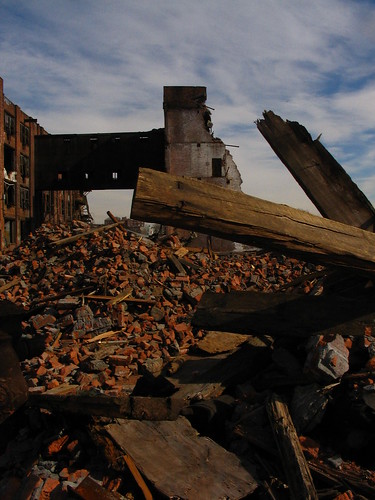
An initial visit to this empty powerhouse in 2007 revealed a surprisingly unique interior, with huge industrial halls dominated by hundreds of graffiti pieces. Many of the squatters' rooms remained intact, with beds, posters, prescriptions and needles left behind as evidence of a rushed eviction. This evocative space was soon featured in an award-winning film about a Brooklyn squatter, "Cave Flower" (2008) directed by Sam Fleischner. A second visit to the Batcave in 2010 revealed further natural decay. Additional holes in the slowly collapsing roof flood water into the building. Mold and rust have overtaken many surfaces. Like a tomb, the empty building still contains many squatters' belongings trapped inside.

The Batcave in 2007

The recent plans to build a new community on the banks of the toxic Gowanus Canal now seem to be part of a faded dream. As last decade's real estate boom collapsed in 2008, the Brooklyn Daily Eagle reported that The "Gowanus Village property is back on the market.... the asking price is $27 million." By 2009, the NY Times had concluded that "New York is, after all, a city where people have proved themselves willing to live almost anywhere, where no location, be it smelly or notorious... seems to be beyond the reach of gentrification. But the case of the Gowanus Canal has put that assumption to an extreme test.... the Gowanus Canal has been left to wait on the verge of metamorphosis, no longer one thing but not yet another."

To date, no one has stepped forward to buy The Gowanus Village property. The land remains abandoned. The Batcave is now being offered for sale by realtor Massey Knakal, which writes simply "Make an Offer."

For additional photos from this expedition, see Bluejake.


Window on the Batcave


The Batcave Revisited


Left Behind


Bike Shop Remains


Ishtar Attacks


Arch Reflections


Portal


Gay Truckers of the World Unite


Ice Cubes at the Sun


Squat Yer Heart Bedroom


Cipher Bedroom


Squatter Living Room


Needle Supply

Long Gone Bedroom

Gowanus: The Whole Foods Lot

The Whole Foods Lot (2008)
February 24, 2010 -

The story of the Whole Foods lot is one of the best examples of how New York City's recent real estate boom and subsequent collapse unfolded. Located at the intersection of 3rd Avenue and 3rd Street, this empty lot is bordered on two sides by the Gowanus Canal. In 2006, it housed an active scrapyard, but this closed when ground was broken for a planned 68,000 square Whole Foods Market, which promised "Brooklyn residents a wide array of natural and organic foods" alongside a public esplanade and community center. The idea of building this market on the banks of a toxic industrial canal struck some local residents as a far-fetched idea, but this was representative of the ambitious yet ill-conceived development projects that were common during the past decade.

Soon after the groundbreaking ceremony, construction came to a halt. Leaking "550 gallon oil drums" were discovered underneath the planned construction site, remnants from the lot's "former life as a petroleum refinery," according to the NY Daily News, "demolishing the company's forecast for a store opening" in 2006. Today, after 4 years of delays, cleanup crews have finally moved in to fulfill Whole Foods' promise to detoxify the property, although the future of their store remains uncertain.

Active Scrap Yard (2006)


Empty Lot, Pre-Graffiti (2007)

The discovery of pollutants wasn't much of a surprise. The Gowanus area is a well known toxic brownfield, and may soon be declared a national Superfund site. In 2007, Science Line reported that "more than a century of industrial misuse, indifferent government oversight, and public apathy have taken their toll. In addition to the garbage and chemical contamination, the canal is a dumping ground for raw sewage.... contaminants such as sulfur, cyanide, asbestos, PCBs, mercury and volatile organic compounds are in and along the canal." This report also revealed that the canal's water was infected with gonorrhea. Whole Foods was aware of the area's industrial history, and had planned from the beginning to work with the Department of Environmental Conservation to clean their brownfield.


Toxic Brownfield (2009)

The industrial history of this specific block can be traced back more then 125 years, to when it was the "five-acre factory complex" of the New York and Long Island Coignet Stone Company, according to the NYC Landmarks Preservation Commission. Only one building from the Coignet complex has survived over the decades - a "pioneering example of concrete construction in the United States" that stands at the corner of 3rd Street and 3rd Avenue. Commonly known as the Coignet Stone Building, this landmarked structure dates back to 1872. Today, it is the only building on the block. Though reportedly not owned by Whole Foods, its fortunes have been closely tied to the fate of their store.

Coignet Stone and Filmmaker (2009)

By 2007, Whole Foods had begun to neglect their property and delay their opening date. Perhaps they had discovered, as the NY Sun wrote, that "cleanup costs are sky-high... much of Gowanus's ground is so contaminated it simply cannot be adequately cleaned up, at any cost." By November 2007, the fence around the lot had "been down for several weeks, angering neighbors" and leaving the site "wide open," according to the NY Daily News. Graffiti artists quickly moved in, turning empty walls into canvases for huge murals. Homeless squatters took over the remaining buildings, including the Coignet landmark, although a local businessman reported "evicting the bums and the rats living there" in 2007, according to The Brooklyn Rail.


Post Graffiti (2009)


Nova (2009)


Violence (2009)


Sleepy Time (2009)

In 2008, the NY Times declared that New York's real estate boom had come to an end. Enthusiasm for the delayed Whole Foods Market began to wane. The NY Sun pondered the wisdom of "opening a store on a toxic floodplain" while Gowanus Lounge grumbled "for the record, it’s been nearly two years since the official “groundbreaking” at the site. Never take those “groundbreakings” to the bank, friends." Brownstoner, meanwhile, reported that the Coignet landmark building was "crumbling" and that "between the barren Whole Foods site and the dilapidated landmark, the corner of 3rd and 3rd currently tells a sorry story about both the past and future of Gowanus." Like similar development projects throughout the city, the Brooklyn Whole Foods project appeared to have stalled.

By 2009, the lot had become completely feral - a wild and marshy wetlands populated by a large group of homeless men living inside the basement of the Coignet building. The only other building on the block, an abandoned warehouse containing a large squatter shack, was burnt to the ground and demolished. A boat washed up on shore, stripped down to the decks, and soon sank. Sculptors, painters, photographers and filmmakers turned the lot into a place the Gowanus Lounge once called "Brooklyn’s biggest toxic playground."


Squatter's Shack (2009)


Sculpture (2009)


Abandoned Boat (2009)

In January 2010, the NY Daily News reported that Whole Foods "company officials concede they have no clue if they'll ever build a store along the polluted waterway... the company is vowing to clean up the mess, but may never build a store." Today, the lot is busy with trailers, backhoes and new fences. Members of a cleanup crew say that work began last week and estimate they will be finished with the lot in about 6 weeks time, by mid-April. "There is not much to clean up here," said one member of the cleanup crew. Just "piles of dirt" and a "few old gas tanks." When they are finished, a portion of the empty lot will be transformed. And it will remain empty.

The Whole Foods project now appears to be just another of the many unrealized schemes of the Bloomberg era. Around the Gowanus, those unfinished projects also include the Gowanus Village, the Toll Brothers development and the Public Place project. As the NY Times wrote in 2009, "the Bloomberg administration, sensing a chance for revitalization, rushed to rezone 25 blocks of the Gowanus area for nonindustrial uses, identifying more than 60 development sites with a potential to generate at least $500 million in tax revenue.... All of these projects were proposed at the height of New York’s real estate boom, and nowadays, regardless of the outcome of the Superfund controversy, some of them look very much like the products of mania."


Clairvoyance (2009)


Squatter's Abandoned Bunker (February, 2010)


Cleanup Crew (February, 2010)


Read (February, 2010)

The Gentrification of Brooklyn


From February 4th to May 16th 2010, the Museum of Contemporary African Diasporan Arts (MoCADA) exhibited a selection of 17 of my photographs as part of a group exhibit titled The Gentrification of Brooklyn. As described by MoCADA, "the exhibition brings together over 20 artists whose work investigates the controversial impact of gentrification on the great borough of Brooklyn.... Each artist presents their own personal critique via work that attempts to decipher and reconcile the sweeping changes taking place in their communities."

The Gentrification of Brooklyn presented an overview of my photographs from Brooklyn's endangered industrial waterfront. As reviewed in Urban Omnibus, these photos "inspire a nostalgic feeling for an old working class Brooklyn that’s being cleared away to create new canvasses for real estate developers." The Indypendent wrote that "the photographs and abstract pieces resonate the most. Many speak without their captions, like one of an abandoned couch by the Sunset Park waterfront." The exhibit was reviewed in numerous other publications, including the NY Times Local and Gothamist.

The No Place


From January to March 2010, the BRIC Rotunda Gallery presented a selection of my photographs as part of a group exhibit titled The No Place. As described by BRIC, The No Place featured "the work of six contemporary artists who conjure utopian and dystopian environments in distinct ways to explore such issues as geo-political conflict, human rights, urban development, the environment, and most broadly, how we comprehend and utilize physical space."

The exhibit included several of my photographs from Brooklyn's off-limits waterfront, such as the image above - Dome Lights (2006) - from inside the Revere Sugar Refinery. These photographs were reviewed by ARTimesNY, which wrote "Nathan Kensinger’s photos document spaces in Brooklyn that haven’t been touched by humans in years.... What do the spaces we leave behind, never consider, or that are inaccessible tell us about ourselves? The work in this exhibition reminded me of the late-artist Gordon Matta Clark who, in the early 1970’s, investigated similar spaces..."

The Bloomberg Era, Part One

The Bloomberg Era, Part One:
What Has Been Lost
December 31st, 2009 - At the end of the first decade of the 21st century, this multi-part photoessay examines how New York City's built environment has changed over the past 10 years, and what the future of New York's skyline might be. Part two of this essay can be seen here.

In the last decade, the skyline and landscape of New York City have been completely transformed. During a 7-year-long real estate boom, which collapsed in 2008, thousands of demolition permits were issued, thousands of new buildings were constructed, and thousands of businesses opened and closed. No neighborhood was left untouched by this boom and its subsequent bust. One man oversaw most of these changes: Mayor Michael Bloomberg, who came to power in 2002. Not since Robert Moses has a single individual presided over such a large-scale transformation of New York City's built environment.

The changes truly began on September 11th, 2001, with the destruction of the iconic Twin Towers of the World Trade Center. This unexpected and traumatizing blow to the New York skyline was followed one month later by the election of Michael Bloomberg. On January 2nd, 2002 Mayor Bloomberg was sworn into office, with the NY Times declaring "The Bloomberg Era begins... times will be tough and sacrifices will need to be made." Few would guess, during this post-9/11 period of mourning, that an era of prosperity and construction unlike many others in New York history would follow. In 2008, the NY Times would describe it as "seven years of nonstop construction, skyrocketing rents and sales prices, and a seemingly endless appetite for luxury housing that transformed gritty and glamorous neighborhoods alike."

The Bloomberg Era

The Bloomberg administration focused on transforming the city's landscape from its very first days in office. As the NY Times wrote in 2009, "the administration’s economic development policies started with a simple concept: New York must grow to compete with other cities. Development became the means toward that end." Bloomberg's pro-development policies created "a historic re-envisioning of New York City, one that loosened the reins on development across the boroughs and pushed more than 100 rezoning measures through a City Council that stamped them all into law... across the city, residential construction doubled under Mr. Bloomberg, to more than 30,000 units a year from 2004 through 2008... Construction spending has also doubled since he took office, reaching a high of $32 billion in 2008"

This construction boom created an equal boom in demolitions. According to The Real Deal, "during the recent building boom, the number of demolition permits rose from 3,386 in 2002 to a high of 6,480 in 2006. The number fell in 2007 to 5,582..." Among the thousands of structures lost over the last decade were many familiar landmarks in the New York skyline, particularly along the edges of New York City. All along the waterfront, from the South Bronx to the Far Rockaways, neighborhoods were affected by the development gold-rush.

As documented by this website, many historic structures were demolished along the industrial waterfront to make way for developers. Neighborhood icons vanished, like the smokestacks of the Long Island City Powerhouse, erased from the skyline in 2005 by luxury condominiums. In Brooklyn, the rapid pace of development claimed so many historic structures that by 2007, the National Trust for Historic Preservation placed Brooklyn's entire industrial waterfront at the top of their list of "America's 11 Most Endangered Places," stating "historic dockyards and factories are being demolished by developers anxious to cash in on the area's newly hip status." Some of the industrial structures lost included the Greenpoint Terminal Market - a potential landmark which was partially burned to the ground in 2006; the Todd Shipyard - a working shipyard demolished in 2006 by Ikea; the Revere Sugar Refinery - a neighborhood icon which guided ships into the Eerie Basin until being demolished in 2007, and the Kent Avenue Powerhouse - a grand structure completely demolished by 2009. Many of the industrial buildings destroyed throughout the decade were functional, stable, useful structures that could have been redeveloped and given a second life.

The Todd Shipyard Drydock (2006)


The Kent Avenue Powerhouse (2008)


The Greenpoint Terminal Market (2007)


The Revere Sugar Refinery (2006)

In a previous era, New York's Landmarks Preservation Commission (LPC) was formed to help defend grand spaces such as these from developers. While some important structures were landmarked in the last decade, including parts of the historic Domino Sugar Refinery, the LPC failed to take a leading role during the development boom. In a 2008 editorial, the NY Times slammed the LPC, saying "the Landmarks Preservation Commission should be a vital part of the planning process in New York City. Instead, it has become a bureaucratic black hole... the landmarking process is routinely outflanked by developers." Additionally, it was shown that landmark status offered no true guarantee of protection, as the LPC reversed its protection of certain designated landmarks, like St. Vincent's Hospital in 2008, or in other cases allowed designated landmarks to slowly collapse, as on the grounds of Bayley-Seton Hospital in Staten Island.

Into the void left by the Landmarks Preservation Commission stepped a small army of concerned citizens. Numerous websites were launched mid-decade to report on what neighborhoods were losing to developers, including Gowanus Lounge, EV Grieve and Lost City. Local historians like Kevin Walsh of Forgotten New York continued to document the obscure, endangered corners of the city. Groups like the Municipal Art Society, the Metropolitan Waterfront Alliance and the Society for Industrial Archeology launched campaigns to save many potential landmarks.

Domino Sugar Refinery (2007)


Bayley-Seton Hospital (2008)

East Village Grief

New York's once colorful commercial landscape was also transformed by the development boom. As property values rose, landlords began "imposing double-digit rent increases," according to the NY Times, squeezing older mom and pop stores out of many neighborhoods. In 2004 alone, according to City Limits, "the city lost 10,000 small businesses." By 2009, New York's streetscape had completely changed, as captured in James and Karla Murray's haunting photography book "Storefront." According to the Murray's, "we included over 225 stores in the book but have photographed hundreds more since we started photographing the mom and pops over 10 years ago. More than half of the businesses in the book are now closed."

Donuts Coffee Shop (Closed 2007)

With the loss of small businesses, the commercial landscape of New York re-oriented towards chain stores - with cookie-cutter exteriors - that could afford to pay exorbitant rents. By mid-decade, New York's commercial streetscape had become dominated by redundancy. A multitude of sterile bank branches opened, while chains like Duane Reade and Starbucks placed multiple store locations within a few blocks of each other, to monopolize neighborhoods. For the first time, big-box-stores were allowed to enter the city, like Home Depot in 2004 and Ikea in 2008, further endangering small businesses. Virginie-Alvine Perrette's award-winning documentary "Twilight Becomes Night" (2008) perfectly encapsulated the loss of small businesses in New York, stating that "large chains, public policy and high rents" were putting NYC's "locally owned stores... on a consistent path towards extinction."

Ikea Rising (2006)

By October of 2008, the NY Times had declared "the credit crisis and the turmoil on Wall Street are bringing New York’s real estate boom to an end.... The real estate boom has been fueled by a robust economy, a steady demand for housing and an abundance of foreign and domestic investors willing to spend tens of billions of dollars on New York real estate... but that ended with the subprime mortgage crisis..." In November of 2008, according to The Real Deal, "The number of demolition permits in New York City fell sharply... indicating a continued construction slowdown in the five boroughs."

Today on the streets of New York, the losses inflicted by the development boom and bust are readily apparent. Like a modern day gold-rush ghost town, empty holes dominate the landscape. Nicknamed "Bloomblight," these holes consist of hundreds of stalled construction projects throughout the five boroughs. On the commercial streetscape, block after block of "prime real estate" sits empty throughout the city. Vacant storefronts dominate once vital commercial strips, especially with the 2009 failure of chain stores like Circuit City and Virgin Megastore. In July 2009, the NY Times reported that "the storefront vacancy rate in Manhattan is now at its highest point since the early 1990s — an estimated 6.5 percent — and is expected to exceed 10 percent by the middle of next year."

In January 2010, Michael Bloomberg will be sworn into power for his third term as the Mayor of New York. As the new decade begins, the future of New York's urban landscape remains unclear.


Sunset Park: Empire Electric

December 16, 2009 -

Built in 1892 as a power plant for the Brooklyn City Railroad Company, this stately red brick warehouse has survived for 117 years in Sunset Park. It was sold to Empire Electric - a distribution and repair company for electric parts - in 1951, according to the NY State Department of Environmental Conservation, and has been abandoned since at least 1998. The entire roof of the structure was reported "missing" in 2002 by the Department of Buildings. Inside, trees, reeds, berries, ferns and moss have clawed out footholds. Layers of graffiti create indecipherable murals on the walls.

Though stripped down to an impressive skeleton, this warehouse appears to be structurally sound. Exposed steel ribs support huge hoisting apparatus and massive pillars are anchored in stepped-pyramid concrete foundations. Despite its appearance of permanence, the future of this historic structure remains unclear. In 2004, the local community board voted in support of buying and demolishing the building to make way for a nearby park at Bush Terminal. Multiple signs outside offer the building for sale.

---
For more photo essays from Brooklyn's Sunset Park please visit Bush Terminal (2007), the Brooklyn Army Terminal (2008), the South Brooklyn Marine Terminal (2009), S & S Machinery (2010) and the 68th Police Precinct (2011).

1892


Steel Ribs


Skeleton


Roof Shards


Fern, Graffiti, Staircase


Portal


Rainstorm


Columns


Berries


Homicide


Clean


In


Foundations