Kent Avenue Powerhouse


June 25th, 2008 -

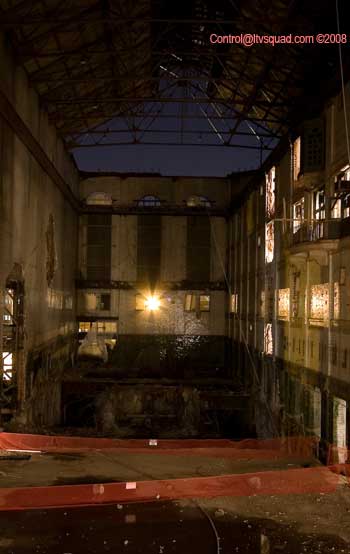
The Kent Avenue Powerhouse - also known as the BRT Powerhouse - is now being demolished. Despite a general public outcry, including a petition and a blog and articles in the NY Times, Gothamist, Curbed, Brownstoner, The Brooklyn Paper, and in many other media outlets, work has proceeded at a rapid pace. The southern third of the complex, where a huge and ornate hall was located, has already been destroyed. These photos document the state of demolition in that section and show what remains in the two other sections of the building - the northern hall, full of equipment, and a second large hall located in the middle of the complex.

These photos were taken on June 21st, 2008. A recent set of photos from May 2008 by the LTV Squad shows what the southern hall looked like before it was destroyed. It is clearly evident that Con Edison has already demolished a major portion of the building, and will soon demolish the rest.

The Kent Avenue Powerhouse was built during 1905 and 1906 to power streetcars and trains. It was sold to Con Edison in 1950 and remained in operation until 1999. In 2008, it was labeled as a candidate for the National Register of Historic Places by the New York State Historic Preservation Office. For more history on the plant, please read the Williamsburg Power Station chapter from Thomas Edward Murray's book "Electrical Power Plants" and visit one of the first and best stories on the demolition at I'm Not Sayin, I'm Just Sayin.

Update: This complex was completely demolished
by July 2009.

Northern Hall


Northern Hall Basement


Basement Furnace


Central Hall


Central Hall and Balcony


Abandoned Offices


Demolition


Basement and Demolition


4th Floor Balcony


Southern Hall Demolition


Destruction of the Southern Third


Southern Wall


Rooftop View


Sunset, Shroud and Navy Yard

Click! at the Brooklyn Museum


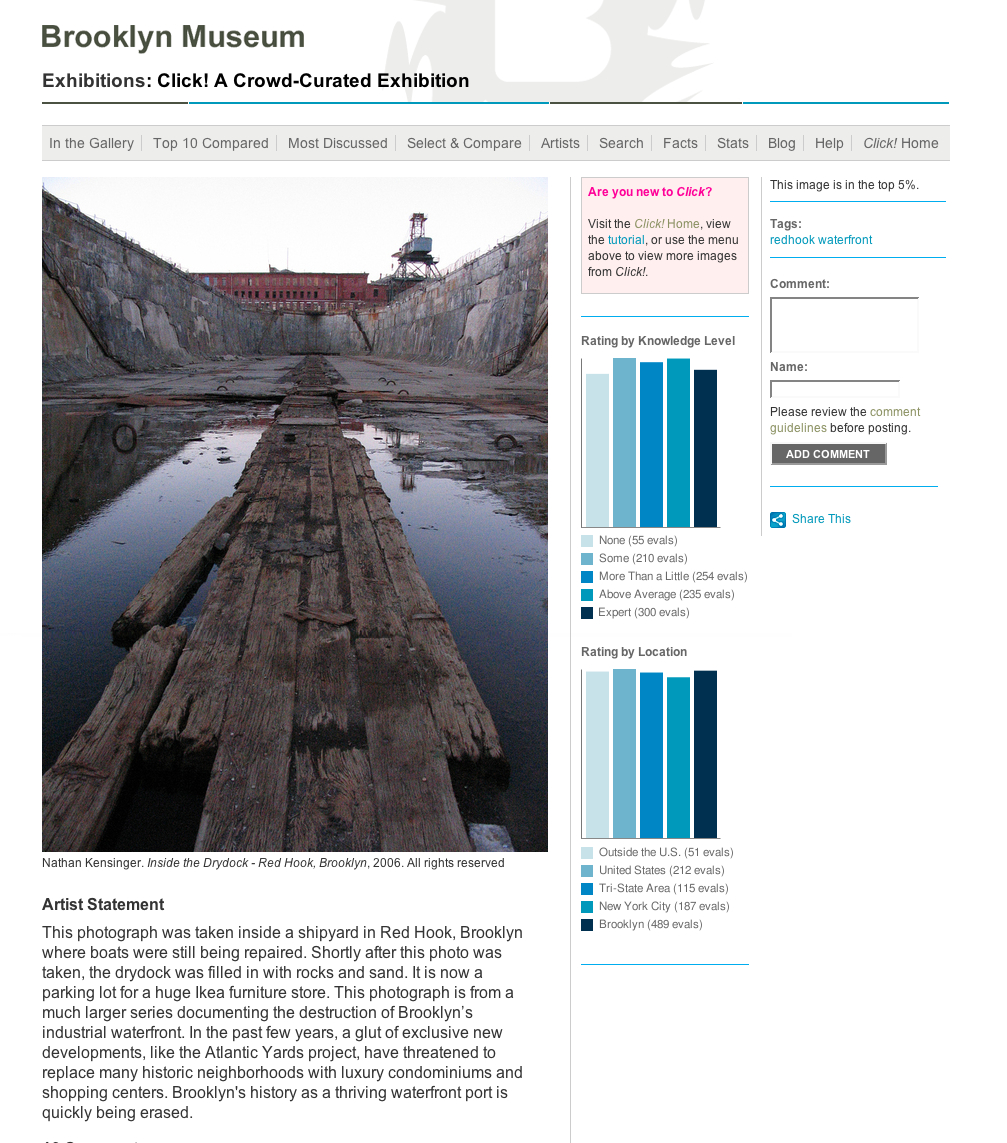
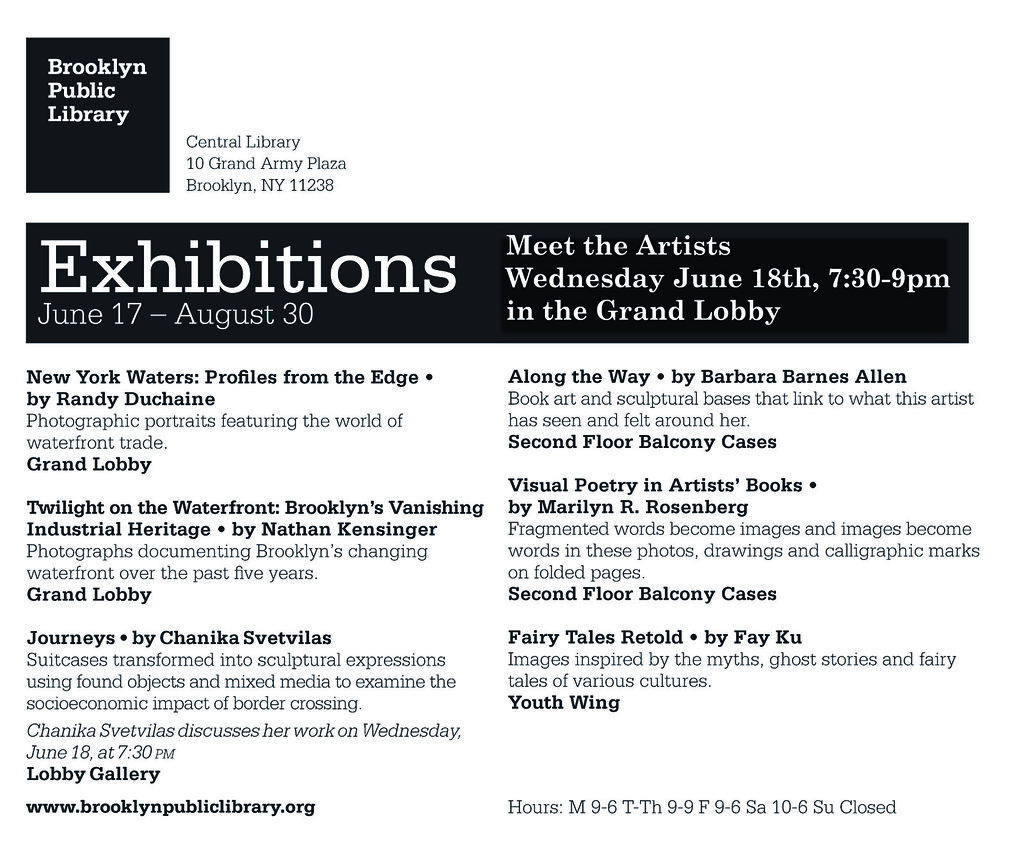
In the summer of 2008, the Brooklyn Museum exhibited one of my photographs of Brooklyn's industrial waterfront at their exhibit Click! The exhibit was just down the street from my solo show at the Brooklyn Library, "Twilight on the Waterfront".

The theme of Click! was "the changing face of Brooklyn." My contribution was a photograph of the Todd Shipyard Drydock in Red Hook, which was destroyed by a new Ikea furniture store. Also included in the exhibit were my frequent photography collaborators Sam Horine and Nate Dorr with their photos of the Red Hook waterfront, which can be seen here and here. Additionally, my friends and fellow photographers Ian Ference, Clara Daly, Tracy Collins, Elizabeth Weinberg and Sonja Shield each had photos in the exhibit that took a unique look at Brooklyn's changing industrial waterfront neighborhoods.

Click! proved to be a controversial show and provoked interesting reactions from the New York Times and the Washington Post. A book including all of the exhibited photographs can be purchased here.


Twilight on the Waterfront: Brooklyn's Vanishing Industrial Heritage


From June 18 through August 30th, 2008, the Brooklyn Public Library featured an exhibition of my photographs titled "Twilight on the Waterfront: Brooklyn's Vanishing Industrial Heritage." This exhibit documented off-limits industrial sites along Brooklyn's waterfront, shedding light on what Brooklyn has lost to development over the last five years. The exhibit was drawn from my long-term photography project about Brooklyn's industrial waterfront and was displayed at the Central Library at Grand Army Plaza, in the Grand Lobby. The official library page for the show can be seen here.

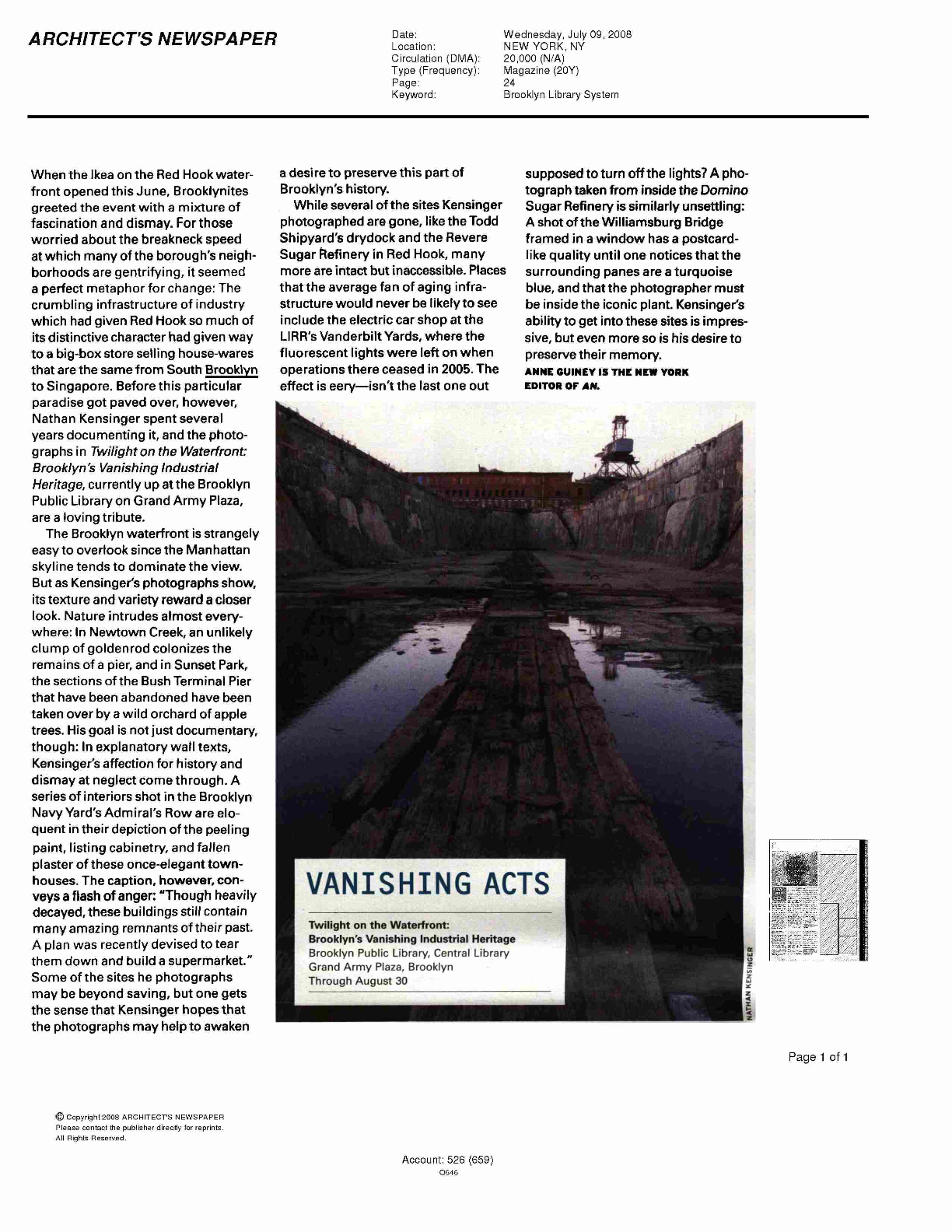
"Twilight on the Waterfront" was featured in a New York Times article and slideshow and was described in a Gothamist review as "an impressive body of work" which "vividly documents the accidental beauty of decaying buildings." The Architects Newspaper stated in its review "the Brooklyn waterfront is strangely easy to overlook since the Manhattan skyline tends to dominate the view. But as Kensinger's photographs show, its texture and variety reward a closer look..."

The exhibit was also featured on Brownstoner, which has described these photographs as "urban guerrilla" photography and "well worth checking out." Finally, the Brooklyn Eagle wrote in their review "after... years of documentary filmmaking, Park Slope resident Nathan Kensinger has, with admirable success, added still photography to his repertoire."

Ironically, this exhibit opened the same day as the new Red Hook Ikea, and featured photos from the Todd Shipyard and the Revere Sugar Refinery, two historic structures destroyed during Ikea's construction. Brooklyn's entire industrial waterfront was recently listed as one of America's "11 most endangered" historic places by the National Trust For Historic Preservation.


Floyd Bennett Airfield


May 15th, 2008 -

Across the street from Dead Horse Bay lies Floyd Bennett Airfield, a part of the National Parks Service's neglected Gateway National Recreation Area. This abandoned airport houses decaying hangars, cracked runways, a ransacked police station, closed-off tunnels, lost boats and antique airplanes, all visible from its empty control tower. Floyd Bennett was New York City's first municipal airport and opened in 1931. Like JFK Airport, it is located on the shores of Jamaica Bay, a vast nature preserve. Its long history includes record-breaking flights by Howard Hughes, Amelia Earhart and "Wrong Way" Corrigan. Today, it hosts cricket players, a large community garden and a shiny new sports complex that has changed the quiet nature of the park.


Department of the Interior


Collapsed Interior


Swim/Nadar


Police Station


Square Windows


Flushing Town Hall


Graffiti Room


Hangar Installation


Boiler Room


Bomber


Nose Gunner


Hangar

Brooklyn Army Terminal


April 30th, 2008 -

The Brooklyn Army Terminal was built in 1919 and designed by architect Cass Gilbert. At completion, it was 5 million square feet in size and covered 97 acres of Sunset Park waterfront. It was used during WWII to ship out over 3 million troops, including Elvis. Today it is owned by New York City and used by over 70 tenants. Like Bush Terminal and the South Brooklyn Marine Terminal to the north and the Bay Ridge freight tracks directly south, the Brooklyn Army Terminal is managed by the New York City Economic Development Corporation (NYCEDC), a corporation responsible for much of the recent redevelopment of New York City's waterfront.

---
For more photo essays from Brooklyn's Sunset Park please visit Bush Terminal (2007), the South Brooklyn Marine Terminal (2009), Empire Electric (2009), S & S Machinery (2010) and the 68th Police Precinct (2011).


Bushwick Inlet


April 15th 2008 -

Bushwick Inlet is a lonely East River cove in Greenpoint, Brooklyn. Bordered by the Bayside Oil Terminal and a large collection of collapsed piers, it is currently a quiet refuge for birds. Like Bush Terminal and Hunters Point South, this is one of New York City's last great pieces of fenced-off industrial wilderness. Bushwick Inlet has a long history as an industrial site, including the building and launching of the ironclad Monitor, which fought a famous naval battle in the Civil War. Today, all this is overgrown with trees, but in the near future the inlet may become a 28-acre city park. Over $100 million has been earmarked by the Parks Department for the purchase and development of the Bayside site, according to a recent report. A second park is planned at 50 Kent Avenue, just south of the inlet. For more on the proposed development of Bushwick Inlet, see Gothamist, Curbed, Brownstoner and the Gowanus Lounge.