The Andrew Freedman Home


January 30, 2013 -

Once a retirement mansion for destitute millionaires, The Andrew Freedman Home is now a house divided. On the ground floor, it presents a restored version of its luxurious past, with a bed and breakfast that includes well appointed bedrooms, spacious ballrooms, an elegant saloon and a grand library. On upper floors, the home is a playground for pigeons that pick through the muck left behind by decades of decay. Though situated on the Grand Concourse, one of the busiest streets in the Bronx, this semi-abandoned New York City Landmark feels more like an urban version of The Overlook Hotel.

Built in 1924, The Andrew Freedman Home "was designed in the Italian Renaissance style," according to a denied Landmark designation request from 1974 (PDF), and is "an imposing limestone structure occupying an entire block facing the Grand Concourse." It was funded by a five million dollar bequest from Andrew Freedman, the "Father of the New York Subway" and a one-time owner of the New York Giants baseball team, whose dying wish in 1915 was to create a home for "aged and indigent gentlefolk... of culture and refinement."

"In short, it was built for indigent capitalists," wrote Vivian Gornick in "A Splendid and Bitter Isolation," a 1980 article for the Village Voice. "It broke Andrew Freedman's heart to think that men who had once held Wall Street in thrall were wandering around broke, not being listened to any more. More than that: it terrified him."  In order to house these sad compatriots, Freedman's bequest was used to create "a large beautiful structure whose interior strongly resembled a great 19th century hotel: carpeted lounges, all velvet wing chairs, marble fireplaces, great arched windows, an oak paneled library, chandeliered dining rooms, bedrooms complete with soft lamps, thick rugs, crisp linen. At dinner, black ties and long dresses, silver service, white-gloved waiters. And no one paid a cent."


Oak Paneled Library


Carpeted Hallway


Furnished Bedroom

In later years, The Andrew Freedman Home's mission would expand to embrace aged intellectuals, including professors, political scientists, painters, and university librarians. By 1983, however, "the increasing cost of maintaining the facility forced the home to close," according to a successful Landmark designation report from 1992 (PDF), and "the building was purchased by the Mid-Bronx Senior Citizens Council as housing for the elderly." The few remaining wealthy residents from the building's past were relocated, to be replaced with a more economically diverse set of retirees. The Council, which still owns the building today, used the ground floor level for a retirement home, daycare and event space, but "much of the rest of the vast building has been kept sealed off like a tomb, a time-capsule monument to the Bronx’s grand past," according to the New York Times.

In 2012, sections of the home's first and second floors were opened to the public for the first time during a unique installation by No Longer Empty titled "This Side of Paradise." The exhibit ran from April until June, and encouraged artists to incorporate artifacts left behind from the building's decaying past -  typewriters, pianos, hair dryers - to connect "the history of the home with the present day realities of the Bronx." Rooms on the first and second floors were given over to a variety of individuals, including graffiti artists, sculptors, and a posthumous installation of work by war photographer Tim Hetherington. A number of the sealed, abandoned rooms on the second floor were reclaimed and transformed into bright, colorful spaces.

"This Side of Paradise (I Lost All My Money in the 
Great Depression and All I Got Was This Room)"
(2012) - Adam Parker Smith


"Furthur" (2012) - DAZE

The upper levels of The Andrew Freedman Home, however, remained virulently derelict. On the third and fourth floors, broken windows let in rain and snow, causing paint to peel and ceilings to collapse. Piles of pigeon droppings grew on many surfaces. Evidence of squatters filled empty rooms, including pornographic magazines and VHS tapes. Other rooms were taken over by unsanctioned graffiti. One was carpeted in dead Christmas trees. These sections of the building were essentially an uncontrolled ruin, albeit one with delicate curtains still hanging on windows and barber chairs waiting for customers. A visiting artist who spent a night at the home in early 2012 was handed "a two-foot-long machete," according to the New York Times, in case she "came across anyone who broke in during the night."

In December 2012, the first floor of this divided home was once again opened to the public. This time, it was offered up as a bed and breakfast named Freedman on the Concourse, a "charming ten room guest house" located "just 20 minutes from New York's Times Square," according to the Mid-Bronx Senior Citizens Council.  At their "delightful, 1920s themed lodging facility," overnight guests can drink in a "vintage speakeasy lounge," run and hide "on our expansive lawns," and sleep on furniture reclaimed from the bedrooms of original residents. Rates start at $175. Rooms are still available for Valentines Day.


---
For other photo essays about art installations that engage historic, damaged New York City spaces, view essays from The Newtown Creek Armada (2012),  The Boatel (2011), House of Cards (2010), This Building has a Story (2010) and The Encampment (2007). No Longer Empty currently has an exhibit titled How Much Do I Owe You on view at an abandoned bank building in Long Island City.

Second Floor Hallway


Christmas Storage


Barber Shop


Doctor's Office


Carpeted Bedroom


Third Floor Hallway


Empty Bedroom


Left Behind


Squatter's Collection


Plastic Wrapped Bedroom


Lace Curtains


Broken Frame

After The Storm

Breezy Point, 11//16/12

December 12, 2012 -

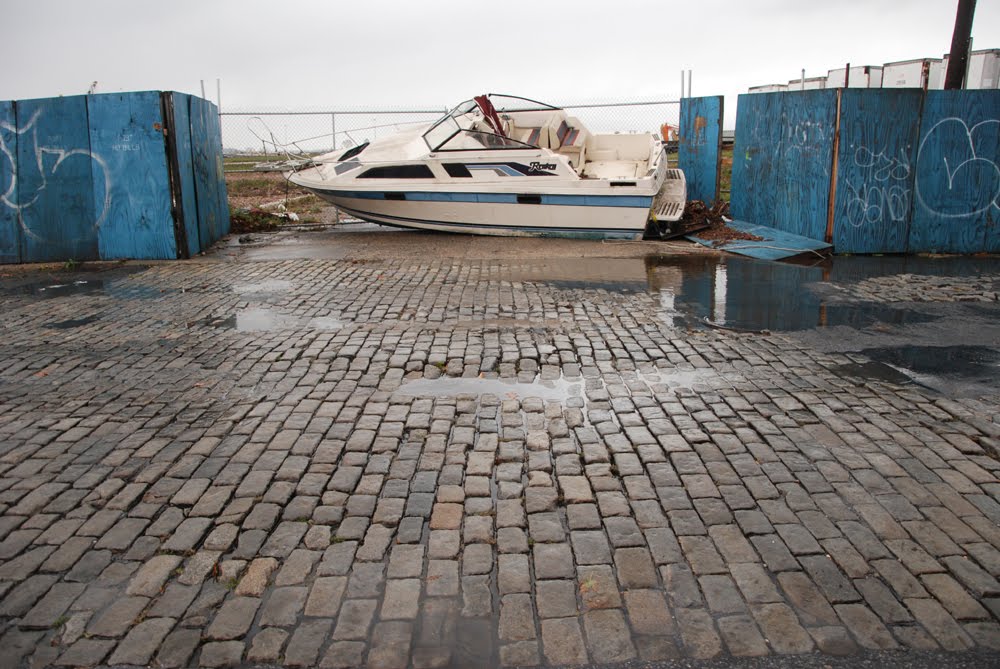
On October 29th, New York City's waterfront was permanently transformed by Hurricane Sandy. During its enormous storm surge, neighborhoods throughout the city were flooded and destroyed. Houses were flattened, floated from their foundations, or pushed into the middle of streets and marshes. Since the storm, I've documented the damage done to many of the areas affected by the hurricane, talking with residents and publishing a series of photo essays at the website Curbed. No matter what type of neighborhood the storm visited, the damage was severe, from the mansions of Belle Harbor and Manhattan Beach, to the gated communities of Breezy Point and Sea Gate, to working class neighborhoods in Staten Island like New Dorp Beach, Fox Beach and Midland Beach, and marginalized neighborhoods like Edgemere and Far Rockaway.

Many of the unique neighborhoods documented on this website over the past 5 years were devastated by the storm. In Brooklyn, Coney Island was entirely submerged, creating enormous damage to homes and property. Alongside the damage in Sea Gate and Manhattan Beach, the hidden world beneath the boardwalk (Coney Island - Under the Boardwalk, March 2009) was largely filled with sand and debris, while the bungalows of Brighton Beach (Brighton Beach Bungalows, March 2010) were flooded, jeopardizing the future of an already endangered community. Businesses and studios in the Brooklyn Navy Yard (Brooklyn Navy Yard photo essays, 2007-2010) were destroyed, while the Superfunded waters of the Gowanus Canal (Gowanus Canal: Toxic Playground, October 2011) and the Newtown Creek (Newtown Creek: Brooklyn Shores, February 2011) overflowed their banks and filled bordering neighborhoods with toxic pollution. Floyd Bennett Field (Camping at Floyd Bennett Field, July 2012), was transformed from a quiet campsite and recreation area into a full scale military operation, with hundreds of trucks, ambulances, tents and humvees positioned to move into the Rockaways.

South Edgemere, 11/1/12

Like Coney Island, the Rockaways were also completely submerged, with water coming in from both the Atlantic Ocean and Jamaica Bay. At the eastern end of the peninsula, in the seaside sections of Far Rockaway (Far Rockaway: Abandoned Bungalows, June 2009) and on the shoreline in northern Edgemere (The North Edgemere Shore, October 2010), nearly every house was flooded, putting an enormous strain on two neighborhoods which had already been struggling to survive. In southern Edgemere (The South Edgemere Wasteland, September 2010), the iconic wooden boardwalk was lifted by the storm surge and pushed far inland. At the 59th street marina, home of The Boatel (Sleeping in the Sommerville Basin, July 2011), dozens of boats were left in a crushed jumble onshore, leaving the marina's future uncertain.  In Hammels (Hammels Wye, December 2010), many more boats were destroyed. The western section of the Rockaways fared the worst, however, with fires and floods destroying many homes in Rockaway Beach, Belle Harbor and Breezy Point.

Staten Island's entire east coast was decimated by a storm surge that rushed inland through marshy areas that border many of its coastal neighborhoods. Blocks from the ocean, homes were pushed off their boundaries, crumbling and submerging into the reeds. Parts of Midland Beach and Fox Beach were wiped off the map, while the bungalows in New Dorp Beach (New Dorp Bungalows, February 2011) were hard hit and the century-old bungalow community of Cedar Grove Beach was left with only two structures remaining. Further south, the freshwater pond at Wolfes Pond Park (Urban Camping in Staten Island, June 2011) was breached by the sea, which crushed several nearby landmarks.

The following 35 photographs are presented chronologically, beginning on the morning after the storm. They were selected from approximately 3,900 photographs which were taken over the past six weeks. These photographs provide only a small glimpse into some of the neighborhoods damaged by the storm. Publishing every one of the millions of photographs that have been taken since the storm passed would not begin to tell the whole story of how New York City's waterfront has been transformed. The cleanup is ongoing and will continue for many months, but has largely moved indoors and out of sight, like an invisible internal hemorrhage that leaves only a few bruises on the skin. In the months to come, the larger toll of the storm will begin to emerge, as homes are demolished or abandoned and businesses go bankrupt. Throughout the city, the same refrain has been repeated by many residents: the waterfront will never be the same.

Gowanus Canal, 10/30/12


Gowanus Canal, 10/30/12


Red Hook, 10/30/12


Red Hook, 10/30/12


Williamsburg, 10/31/12


South Edgemere, 11/1/12


South Edgemere, 11/1/12


North Edgemere, 11/1/12


Hammels, 11/1/12


Rockaway Park, 11/1/12


Belle Harbor, 11/1/12


Stapleton, 11/03/12


Midland Beach, 11/03/12


Midland Beach, 11/03/12


New Dorp Beach, 11/03/12


New Dorp Beach, 11/03/12


Cedar Grove Beach, 11/03/12


Great Kills, 11/03/12


Great Kills, 11/03/12


Sea Gate, 11/11/12


Sea Gate, 11/11/12


Sea Gate, 11/11/12


Manhattan Beach, 11/11/12


Manhattan Beach, 11/11/12


Fort Tilden, 11/16/12


Breezy Point, 11/16/12


Breezy Point, 11/16/12


Breezy Point, 11/16/12


Breezy Point, 11/16/12


Jacob Riis Park, 11/16/12


Jacob Riis Park, 11/16/12 


Wolfes Pond, 12/3/12


Fox Beach, 12/3/12


Fox Beach, 12/3/12


Fox Beach, 12/3/12

Hurricane Sandy Photo Essays


November 20, 2012 -

Three weeks ago, Hurricane Sandy landed in New York, causing enormous devastation to the city's waterfront. Many of the unique neighborhoods documented on this website in the past five years were flooded or destroyed by the storm.

During the past three weeks, the website Curbed published a series of my photo essays documenting the storm's impact. This ongoing series includes post-storm surveys of damage in Gowanus, Red Hook and Dumbo (10/30/12), the Far Rockaways (11/2/12), Staten Island (11/5/12) and the cleanup in the Rockaways (11/19/12). These photo essays are part of my ongoing column for Curbed, titled Camera Obscura.

A longer photo essay examining the storm's impact - titled After The Storm - was published on this website in December 2012.