October 20, 2010 - This photo essay is part of a three part series exploring Edgemere, an isolated waterfront neighborhood in The Rockaways. Each photo essay focuses on one of Edgemere's three distinct geographic areas: The South Edgemere Wasteland, The North Edgemere Shore and The Edgemere Landfill.
Edgemere is a Queens waterfront neighborhood divided in two. In the south, a vast wasteland covers over 20 blocks of Rockaway oceanfront. In the north, residents live along the shores of Jamaica Bay. Once, this community was a thriving summer resort with its own airport. Today, north Edgemere is sandwiched between the wasteland and a decommissioned toxic landfill, and is troubled by a long history of floods, gang warfare, and government neglect. The NY Times once described the area as "the 'sixth borough,' an isolated place forgotten by politicians and the news media and stuck with poor schools and hospitals, as well as a lack of decent stores, jobs, transportation and youth programs. [Where] instead of attending summer programs, many young children learn the terminology of drug selling and shooting 9 millimeter pistols."
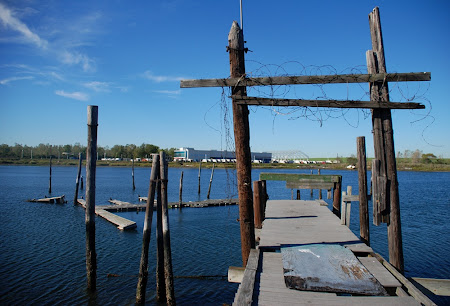
Although midtown Manhattan is visible from its shores, northern Edgemere has more in common with a rural Southern backwater. Its waterfront consists of three small inlets - Sommerville Basin, Little Bay (aka Conch Basin), and Norton Basin. Cluttered with abandoned piers, they are used as dumping grounds for boats, cars and bodies. Neighborhood fishermen trespass into empty lots to ply the waters as wild dogs roam nearby. Just inland, abandoned bungalows line muddy dirt roads and boats are stowed in backyard docks. Looming over this quiet neighborhood are two of the most notorious housing projects in New York City.
 Conch Basin Shore
In 2001, a member of Edgemere's Community Board told the
NY Times that "the Rockaways is really one of the furthest points from City Hall... [and] have been used as a Siberia, where the city has sent its problems.'' Current residents of Edgemere tend to agree. One described it as "like living in the Sahara. But with people," while a second called it "the bottom of the barrel." Another resident spoke of taking long train rides to Times Square "just to see the crowds," and then returning to his dirt road in Edgemere, where he was "all alone."
It wasn't always so desolate.
Founded in 1892, Edgemere was originally named "New Venice, in reference to Jamaica Bay’s marshland and natural canals," according the NYC Department of Parks and Recreation, and by 1925, "Edgemere began to emerge as the Rockaways’ commercial hub." By 1940, it was home to the Rockaway Airport, which "
consisted of over 200 acres" between Sommerville and Conch Basins, according to
Abandoned & Little-Known Airfields. Through the 1950's, summer bungalows and hotels lined the streets from Jamaica Bay to the Atlantic Ocean. "In the old days, all told, there were 6o plus hotels in Edgemere," according to "
The Rockaways" by Emil R. Lucev, and establishments like "The Cozy Corner," which was "Rockaways nicest place for refreshment... situated in the shore of Jamaica Bay in Edgemere."
 Bungalow Home
 Abandoned Bungalow
Even during its summer resort heyday, the neighborhood had a history of flooding. In the 1930's, "the Edgemere section flooded at the mere mention of rain," according to "
The Rockaways," because it was "the low point of the Rockaway Penninsula." Flooding continued throughout the century. After a 1991 storm, "
certain parts of the Rockaways and Broad Channel were under 4-6 feet of water... in the Edgemere neighborhood the ocean met the bay for the first time since the hurricane of 1944," according to The Wave. North Edgemere still floods regularly each year, according to locals, with water rising 2 to 3 feet. "The Rockaways are sinking," claimed one resident, while another stated "dig down five feet and you'll hit water." New storm drains are currently being installed by the city, which may help reduce the problem.
 Street Flood
By the 1960's, the Rockaways had fallen out of favor as a summer retreat. Thousands of bungalows were bulldozed in
south Edgemere and other neighborhoods, and "Rockaway's isolation and open spaces tempted public officials to regard the area as a convenient place to relocate poor minorities out of the center of the city," according to Lawrence and Carol Kaplan, authors of "
Between Ocean and City: The Transformation of Rockaway New York," who wrote that "for more than two decades, public housing developments were built in the Rockaways that eventually came to be occupied largely by a welfare population... Rockaway residents frequently used the term "dumping" to describe the process by which New York City moved deprived, helpless, and troubled individuals and families to its community.... Social services were notable for their absence... Crime and substance abuse rates increased. The figures for unemployment, infant mortality, infectious diseases, school dropouts, and, later, HIV/AIDS became among the highest in all of New York City."
By 2002, there were "more than 5,000 units of public housing on the eastern end of the peninsula, one of the city's highest concentrations of public housing," according to the
NY Times. The Edgemere community is bookended by two of these housing projects. To the west are the
Ocean Bay Apartments, which were built on top of the Rockaway Airport in 1961. Still known by their former name, the Edgemere Houses, they were "long considered one of the city's most crime-ridden housing complexes," according to the
NY Times. "Cops at one time called [it] "Edgefear" because it was the worst public housing in the city by any indicator you care to choose," according to
The Wave. To the east, at the opposite end of the neighborhood, lie the
Beach 41st Street/Beach Channel Drive Houses, which look out over Norton Basin. Known as The 40's, this complex has a history of violence that rivals the Edgemere Houses. "The kids drink beer, they smoke reefer, they talk trash, and then they fight," one resident told the
NY Times in 2005, while another resident stated "these kids, they shoot at the sky, they go in the roof and shoot down at people, they shoot wherever they like."
Edgemere's two housing projects are rivals in a long-running gang war that spans the Rockaways. "The intramural hatred and violence among housing projects in the Rockaways goes back decades, pitting residents of one complex against another," according to the
NY Times. In 2004, "it was Edgemere versus the 40's," one 15 year-old shooting victim told the newspaper. "We can't even walk through their project. It's always been that way."
 Norton Basin and the 40's
Edgemere's gang activity is by no means a thing of the past. The residential area between the Edgemere Houses and The 40's shows ample sign of gang activity. Like
Far Rockaway, gang graffiti covers many homes and buildings, and several abandoned bungalows have been taken over by local gangs. Two months ago, in August 2010, 36 members of "The Handsome Hustlers" gang - including a 12 year-old girl - were arrested in Edgemere for "selling crack and powdered cocaine, oxycodone, marijuana and other controlled substances," according to
The Wave. And in April, 2010, police arrested 84 members of a multi-gang alliance called "Flocc" which was responsible for "two homicides, numerous gang shootings, a plot to murder police officers on foot patrol in Jamaica, Queens... 60 handguns, more than five kilograms of cocaine, 567 decks of heroin, two pounds of marijuana and approximately $50,000 in narcotics proceeds," according to
The Wave. Many of Flocc's members were from Edgemere, and had "turned the seaside Queens neighborhood of
Far Rockaway into a war zone."
One resident succinctly summarized the problem for the
NY Times, saying "What other outlets do these kids have? Trouble is the easiest thing to get into because it's always there. It's crabs in a bucket out here. They're all climbing up over each other to get out, but meanwhile they're all pulling each other back down."
 Gang Bungalow
 Bungalow Interior
Despite these problems, the north Edgemere shore is relatively calm and serene in the daytime. Crab fishermen and anglers work the waters amidst wrecked boats and cars, sometimes making gruesome finds. In 2000, "a fisherman found a man's head in a black plastic bag on the shore," according to the
NY Times, and "a short time later, detectives found the body that went with the head in an abandoned car nearby." Recently, neighborhood students have participated in several shore cleanups organized by the
Rockaway Waterfront Alliance, a local group working to "strengthen the connection between the community and the waterfront." The Edgemere bays are now a destination for birdwatching.
 Abandoned Car
In recent years, the city has shown some interest in north Edgemere. At least 210 new units of housing have been constructed inside the "Edgemere Urban Renewal Area," according to the
Margert Community Corporation, and "the housing authority has spent a significant amount of money renovating all the apartments, thousands of units," at the Edgemere Houses, a Community Board member told the
NY Times. However, despite these signs of increased city attention and support, northern Edgemere is still a neighborhood visibly scarred by gangs, floods, and neglect.
Perhaps the poet Lawrence Ferlinghetti best summarizes the neighborhood's history in his poem "
A Far Rockaway of the Heart," writing "How transient these/solid ephemeral buildings/Concrete bastions/piled up brick and mortar/Wooden caravansaries/built on sand/[...]How fragile the bodies pulsing in them/(Each a temporary shell housing a life)."
 Abandoned Piers
 Crab Fishermen, Wrecked Boat
 Head of Conch Bay
 Miss Luscious in the Bushes
 Norton Basin Piers
 Graffiti and Bay
 Empty Home
 In The Clubhouse
 Locked Door
 Gang Graffiti
 Shore Shack
 Dirt Road, Shotgun Shack
 Abandoned Mustang
 Condemned Bungalow
 Empty Courtyard
 North Edgemere Sunset
 November 10, 2010 - This photo essay is part of a three part series exploring Edgemere, an isolated waterfront neighborhood in The Rockaways. Each photo essay focuses on one of Edgemere's three distinct geographic areas: The South Edgemere Wasteland, The North Edgemere Shore and The Edgemere Landfill.
 Mount Edgemere Cap
 Edgemere Trench Road
 Cap and Motor
 Landfill Road
 Abandoned Trailers
 Squatter Couch
 Sanitation Office
 Abandoned Boat
 Boat Interior
 Landfill Breach
 Beach Chair in the Breach
 Metal Shard Roots
 Doll Head
 Barnacle Bottle
 Bottle Beach
 To The Breach
 To The Shore