Coney Island: The Freak's Domain


November 25th, 2008 -

Up until this summer on the Coney Island boardwalk, you could shoot the freak. Some people aimed for the face. One father shot his freak son. The freak's domain was an abandoned lot filled with trash and thousands of decaying paintballs turning into mud. The freak's frontyard concealed an entrance to the strange world under the boardwalk, with long forgotten hamburger signs, picnic tables and strange lairs. Hidden in the freak's backyard was a concrete porch looking out on a vast empty plain that was once Coney Island's Go-Kart track, batting cage and mini-golf course. Beyond this empty lot lies the Wonder Wheel, which is now surrounded by the demolition of Astroland. The home of the freak, like the gritty spirit of modern Coney Island, may be gone by next summer, replaced by the promise of luxury condominiums.

---
Update: In December 2010, Shoot The Freak was demolished by its landlord. “They came like thieves in the night,” the booth's owner told The Brooklyn Paper. “Those little sneaks emptied out the place and there is nothing left.” For other photo essays from abandoned Coney Island, visit Coney Island Creek (2007), Under The Boardwalk (2009) and Abandoned Playland (2011).

In the Freak's Lot


Freak


Freak's Friend


Live Human Targets


Freak's Backyard: The World


Freak's Frontyard: Under the Boardwalk


Under the Boardwalk


Forgotten Franks


Front Gate

Inside the Prison Ship Martyrs Monument, Fort Greene


November 10, 2008 -

Fort Green Park in Brooklyn is a small, hilly park designed by Olmstead and Vaux. Underneath this park lies a crypt with bones from 11,500 prisoners-of-war: men, women and children who died onboard British prison ships during the Revolutionary War. Their bodies were thrown overboard into the East River or buried on its sandy banks, on ground that would become the Brooklyn Navy Yard. For decades after the war, Brooklyn residents would collect their bones as they washed up on shore. Human remains were being discovered in the Navy Yard up until 1900.

Above this crypt is the Prison Ship Martyrs Monument. Designed by famed architects McKim, Meade and White, it was dedicated in 1908 by President-elect William Howard Taft. The monument and crypt are considered sacred ground, and have been closed to the public for over 70 years. They have had a difficult history, including a 1914 eagle theft, the crypt vandals of 1923, an ongoing four-decade-long borough feud over missing eagles, and park restorations in 1937, 1949, 1973 and 1995 to recover from vandalism and neglect. By the year 2000 the monument was missing plaques, the crypt had a plywood door, and the eternal flame had long been extinguished.

On November 15th, the Fort Greene Park Conservancy will commemorate the 100th Anniversary of the Prison Ship Martyrs Monument with a day of celebration. This will mark the end of the latest restoration period, the eternal flame will be relighted, and Brooklyn's missing eagles will be rededicated. There will be Revolutionary War re-enactments, a parade and 21-gun salute, a choral work called "Brooklyn Bones." (Update: Photos of the celebration can be seen here)


Victim Services - Stapleton, Staten Island


October 29th, 2008 -

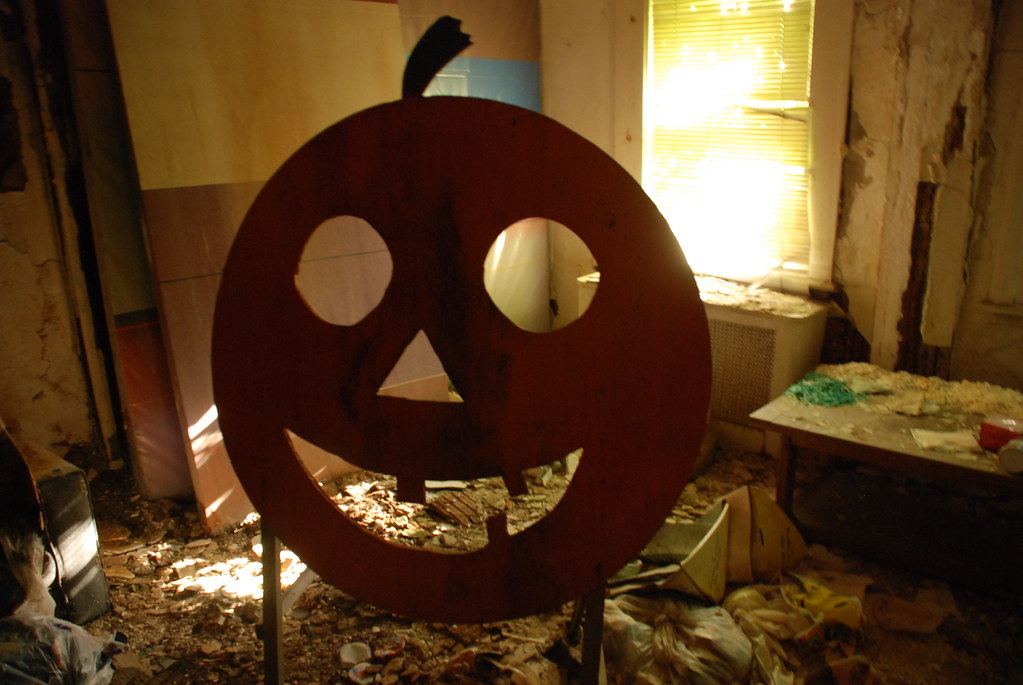
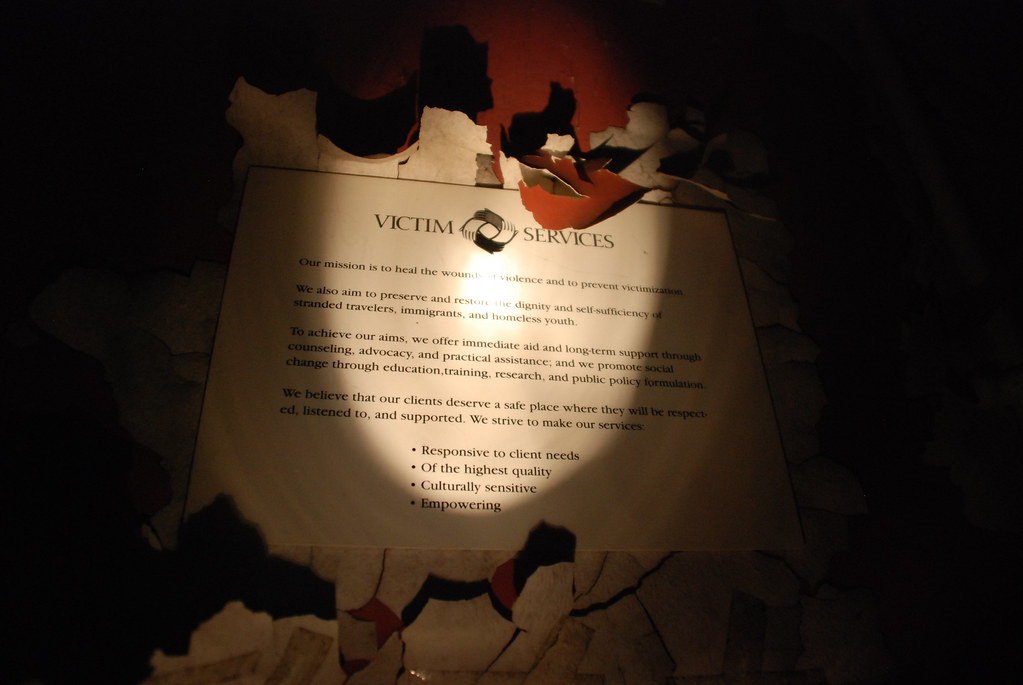
A haunted house is slowly deteriorating on the grounds of a half-abandoned hospital in Staten Island. A piano rots on the collapsing front porch. Inside, there are boxes of severed plaster hands and troll priests. The living room is dominated by a giant jack-o-lantern, while the upper floors show signs this was once home to several children: rusty cribs, broken dolls and tiny, dusty winter coats hanging in a closest. In a dark basement, a poster declares "No One Deserves to be Abused." This was once the Victim Services center of Bayley-Seton Hospital, whose mission was to "restore the dignity... of stranded travelers, immigrants and homeless youth."

But what is most haunting - apart from this sordid past - is the fact that this neglected building is a New York City Landmark. Built in 1842 by unknown architects, the house was landmarked in 1985. The Landmarks Commission's designation report describes the building as "a relatively severe structure" that was once used as the Physician-in-Chief's residence, providing a home to "more then 20 of the hospital's chief medical officers," including a future Surgeon General. The report also states that "the lavishness of the interior provides an unexpected contrast to the severity of the exterior." Today there is no trace of that lavish interior and though it appears somewhat structurally sound, this decaying 166-year-old landmark - like the hospital around it - has a very uncertain future.

When combined with yesterday's decision by the Landmarks Commission to allow St Vincent's Hospital to demolish several of its historic buildings, this is adding up to a grim Halloween for New York's landmarked hospitals.

Additional photos from this exploration - taken by Nate Dorr - can be seen here.


Newtown Creek: The Dutch Kills


October 21, 2008 -

On the Queens side of the Newtown Creek, several small freight lines diverge from the waterfront. Some tracks lead to the Sunnyside Yards, some wander off into dense foliage before disappearing, and others cross rusted old bridges above the Dutch Kills - the northern branch of the Newtown Creek. Beneath this tangled web of tracks, roadways, overpasses, dirt paths and wood-plank walkways lies the creek itself. Its waters are a dark, unnatural green. Nothing appears to live in them. The Newtown Creek is considered to be America's most polluted body of water, and the world's largest urban oil spill. However, as on the south side of the creek, it can also be a quiet haven in the heart of this industrial dead zone.

---
For other photo essays from the Newtown Creek, visit Newtown Creek: Brooklyn Shores (2011), Secret Parties (2009), and Linden Hill Tracks (2007).


The 2008 Red Hook Film Festival


The 2nd annual Red Hook International Film Festival took place in October 2008. It was hosted by the Brooklyn Waterfront Artists Coalition (BWAC) screening room and had free short films, free popcorn, and free Steve's Key Lime Pie. The complete schedule and awards for the festival can be seen here.

As the Festival Director, I made sure to include several great films about industrial New York, including "North Brother" - an exploration of abandoned North Brother Island in the East River, "City of Water" - a great film about the future of New York's waterways, and "Cave Flower" - a love story filmed inside The Batcave on the Gowanus Canal. The festival concluded with several films about old-school New York businesses, including an excerpt from "Counter/Culture" by talented photographers James and Karla Murray, and "Twilight Becomes Night" - a portrait of NYC's dying mom & pop businesses.

The Batcave

New York Waters

Wrigley Building - Rosebank, Staten Island

September 9th, 2008 -

The Wrigley Building is an abandoned 1917 chewing gum factory in Rosebank and part of Staten Island's historic chewing gum heritage. Modern chewing gum was invented on the island with the help of General Santa Ana, the former eleven-time President of Mexico. In 1869, while living in exile on the island, he sold a ton of Mexican chicle to local inventor Thomas Adams. Adams hoped to make rubber tires from the substance. Instead, he created chewing gum. By 1884, he had introduced the world's first flavored stick of gum - Black Jack - which opened the door for future chewing gum kings like the Wrigley Brothers.

The Wrigley Building, referred to in a recent New York Times article about Rosebank, was once used to process chicle. It is not clear when the factory was abandoned, but numerous reports of squatters living in the factory and "kids hanging out in it" date back to 1990. It is now empty, like the abandoned ice factory across the street and the color works nearby. As Rosebank's transformation from industrial to residential continues, this historic factory may soon become a condominium with "92 luxury units."

For further information on gum, read "Chewing Gum: An Unofficial History."