February 28, 2011 -
The waterfront of New Dorp, on Staten Island's east shore, has been permanently scarred by eminent domain and city neglect. Once, this was a popular summer resort area known as the "Poor Man's Bermuda," according to the Village Voice, and the neighborhood's two beaches - New Dorp Beach & Cedar Grove Beach - were lined with summer bungalows, grand hotels and piers. Today, both beaches are part of the NYC Department of Parks & Recreation's 315-acre Great Kills Park, and are quiet and deserted in the winter. Their shoreline bungalows are now vacant or were demolished decades ago.
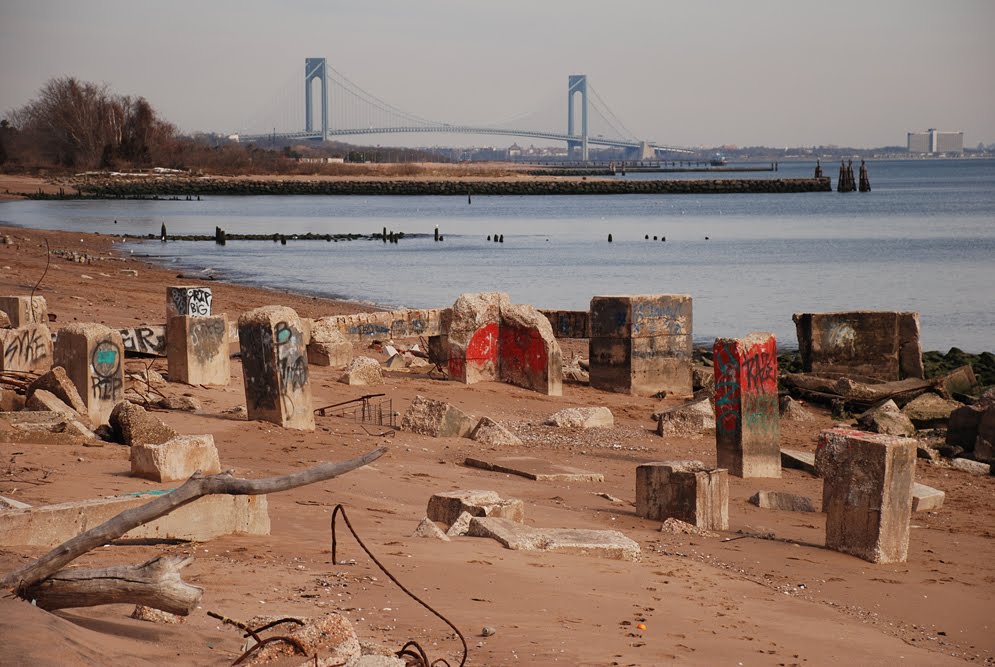
Although both of New Dorp's beaches are owned by the Parks Department, they are a study in contrasts. The sands of New Dorp Beach are filthy, covered in debris and washed up bottles, and scattered with decades-old hospital ruins. Just above the beach, the former resort area has become a haven for homeless camps, teenage drinking and public sex, according to New Dorp residents. Cedar Grove Beach, on the other hand, was recently considered so pristine "you could eat off the sand," according to one local. Until this winter, the beach was regularly raked and cleaned by the Cedar Grove Beach Club, a century-old community of summer bungalow residents who rented their beachfront cottages from the city. In October 2010, the Parks Department - despite their abject failure to maintain New Dorp Beach - evicted the Cedar Grove Beach residents and fenced off their bungalows. They are now planning to demolish these historic homes.
 Cedar Grove Beach Bungalows
 New Dorp Beach Ruins
 New Dorp's shoreline has a long history of human occupation. "Like all of Staten Island, the area of New Dorp was populated by American Indians going back over 10,000 years," according to
Wikipedia. Local residents claim to have found arrowheads and spearheads from this era on the local beaches. In 1671, New Dorp Beach became "the home of the second permanent European settlement in Staten Island," according to the
Parks Department, but it wasn't until the late 1800's that the beach area became heavily developed. "After the Civil War, the area began to prosper as a resort, as campgrounds and seasonal bungalows began to develop along the gridded side streets along Cedar Grove Avenue. Along the waterfront, wooden piers and hotels popped up," according to
Wikipedia. Many small bungalows still remain standing inland, crowded onto these narrow one way streets.
 New Dorp Bungalow #1
 New Dorp Bungalow #2
The neighborhood's grand hotels included The New Dorp Beach Hotel, "which contained about 100 rooms," according to the
NY Times. Built in the late 1800's by Edward Hett - "the inventor of the multi color printing press," according to the
NY Times - it burned to the ground in 1902. Soon after, a 1909 fire destroyed parts of a hotel complex owned by Felix Bohm, according to the
NY Times. "The beach was crowded with visitors who saw a very spectacular show, free of charge. A high wind was blowing and the flames soon extended to the dancing pavilion, bathing pavilion and a bowling alley, all of which were destroyed." Artifacts from this era still wash up on New Dorp Beach, and many residents have become amateur beach combers. One local described having over 150 antique bottles in her nearby bungalow, and told of finding beer steins, coins and jewelry from the hotel era.
 New Dorp Beach
  New Dorp Beach Bottle
The bungalow-lined streets of New Dorp once "extended all the way to the beach," according to the
Staten Island Advance. But, like bungalow communities throughout New York City, New Dorp's beachfront bungalows were threatened with extinction by Robert Moses. In the area adjacent to New Dorp Beach, "the city demolished the beach-side properties in 1962, citing eminent domain, to facilitate Robert Moses' plan to build a shoreline drive, part of his vision of parkways throughout the city," according to the
Staten Island Advance. "That plan was abandoned in the 1970s, leaving the woods empty and the community in a bit of a backwater." Few artifacts remain inside this former bungalow area, which is now part of Great Kills Park. Crumbled sidewalks are buried under the dirt and old fire hydrants are overgrown with ivy.
 Demapped Bungalow Street
  Hydrant and Ivy
 Younger residents of New Dorp Beach, who grew up after these bungalows were demolished, remember that "the woods were a myriad of paths that they knew like the back of their hand, dotted with tree forts and BMX ramps and later a haven for underage drinking," according to the
Staten Island Advance. There are now several homeless camps hidden in this wilderness. Tents, fire pits and shanties are built deep in the park's woods. Baby lotion and blankets are found next to paths. One area, recently burned, is now a cratered wasteland covered in melted car parts. Further south, the ruins of Seaside Hospital, also know as the Staten Island Area Station Hospital, tumble out of the woods and onto the beach in "an apocalyptic scene," according to the
Staten Island Advance. Like the New Dorp Beach bungalows, "the facility was demolished in 1964 to make way for the proposed parkway."
 At the Fire Pit
  Campsite
  Tent
Tent Just to the south of this blighted parkland, the residents of the Cedar Grove Beach bungalow community grew up in a vastly different environment. Somehow, their bungalow's were seized by eminent domain but spared from demolition. "Cedar Grove, one of dozens of beach colonies that dotted the shoreline during the borough's heyday as a resort community, was condemned and acquired by the city in 1958" for Robert Moses' planned parkway, according to
The Staten Island Advance. "When the parkway failed to materialize, the city agreed to lease back the land with the understanding it could take it back whenever it wanted." In the ensuing decades, generations of families have been raised in these seasonal bungalows. "Many of them in this century-old resort trace their relatives back five generations," according to the
NY Times.
More than one New Dorp resident described visiting the Cedar Grove Beach community as being like going back in time. "Where New Dorp [Beach] appears to have been abandoned, Cedar Grove is immaculate. The residents sift the sand regularly with a beachcomber the club bought for $80,000. There's not a speck of trash to be seen," the
Village Voice reported last fall. "When you step through that gate, it's like it's 1930 all over again," one resident told the Voice. The Cedar Grove Beach Club maintained the beach and the grounds around the bungalows, and "paid the city about $140,000 a year" in rent, according to the
NY Times. Access to the beach was open to the public.
 Cedar Grove Beach Trio
  Cedar Grove Beach Bungalow
John Murphy, who was raised in a Cedar Grove Beach bungalow, recalls a close knit community that worked hard to maintain their properties. His parents bought their bungalow in the 1950's, and when it was seized by the government, they rented it back from the city. Up until this October, John lived in his family bungalow almost year round, spending winters in a warmer climate. Although the roof leaked "like a sieve," he patched it every year, and when a nor'easter dumped so much sand on his front porch that you "could walk up onto the roof," he rented a bulldozer to clear the property. Other community residents recall pitching in to help rebuild their clubhouse one summer, "after it was destroyed by vandals," according to the
Village Voice.
In October 2010, the NYC Department of Parks & Recreation evicted the Cedar Grove Beach community, claiming it wanted "improved access" to the beach. John Murphy says he was the last to leave the bungalows. The fence was already up around his childhood home, and he left his American flag flying on the flagpole. Like many of the residents of Cedar Grove Beach, he is not sure what he will do now, but hopes that the city will have a change of heart. All along the fenced off bungalows, belongings have been left behind, as though there may somehow be another summer season. Barbecues, beach toys, hammocks and boats line the empty sands.
 Cedar Grove Beach Remains
  Cedar Grove Beach Chairs
 Despite the current budget crisis in New York City, the NYC Department of Parks & Recreation does not appear to be wavering from their plan to demolish the Cedar Grove Beach bungalows. According to a Parks Department
document from February 10, 2011, "the proposed action involves the rehabilitation of Cedar Grove Beach, with the main goal being to provide improved access to this area for the general public... The project is divided into two phases: Phase one includes demolition of a majority of the structures on site... Phase two involves construction of a new playground and new bike path." No mention is made of improving on the already demolished ruins of nearby New Dorp Beach.
Many have questioned the wisdom of evicting paying tenants in the middle of a fiscal crisis. “It’s illogical for the city, at a time of severe budget pressures, layoffs and cuts, to kick out a community that provides revenue to the city,” U.S. Representative Michael McMahon told the
Staten Island Advance. According to
The New York Observer, "It will cost millions of dollars in capital money to tear down the houses and reopen the stretch next year, which is and has always been publicly accessible. At the same time, beaches across the city, including some just up the shore, have been closed due to lack of funds." Budget constraints may have already snarled the Park Department's plans: "The transformation of Cedar Grove Beach into a public park... may still be three years away.... the latest documents show completion is now expected by 2014,"
The Staten Island Advance reported on February 26th.
In the meantime, at least one empty bungalow has been rented out by the city as a filming location for the HBO series "Boardwalk Empire," according to a
NY1 report from February 19th, much to the dismay of former residents. "'I think it's a little hypocritical,' said former Cedar Grove resident John Murphy. 'They said they're going to open it up to the public, and obviously they're not doing that. But private concerns can actually use it, and I think that's very wrong.'" Residents have organized a facebook page (
Save Cedar Grove Beach Club) and a website (
savecedargrovebeach.com) to contine their struggle to save these historic structures. For now, the Cedar Grove Beach bungalows are locked away, patrolled by a full time security guard, and awaiting their fate.
---
For more photo essays from New York City's endangered bungalow communities, please visit Brighton Beach Bungalows (2010), Hammels Wye (2010), The North Edgemere Shore (2010) and Far Rockaway: Abandoned Bungalows (2009). Cedar Grove Beach: Authorized Personnel
  Cedar Grove Beach: No Trespassing
 New Dorp Beach Apocalypse: Seaside Hospital Ruins
  New Dorp Beach Fire
 Cedar Grove Beach Chair Bungalow
 New Dorp Chair
 Cedar Grove Beach: Locked Out
  New Dorp Beach: RIP
 April 28, 2011 -
 Ohrbach Lake
  Docked
 Down in the Valley
  Scout Skills
  Black Oak Lean-Tos
 Yellow Pine Cabin
 Dark Shadows
 Pouch Amphitheater
 Not For Sale
 P.O.P
P.O.P Hill Pond Lean-tos
 On The Trail
 Fire
Fire Scout Knot
 Ropes Course
 Bazooka
 Lumberjack Director
 Island Bridge
 On Lee A. Ellison Island
 South of the Border